
FF360
Fire Protection Foam
FIRESTOP TESTED FOR THROUGH-PENETRATION APPLICATIONS UP TO 2 HOURS
UL CLASSIFIED

Key Benefits:
In Case of a fire the intumescent material
expands, sealing the ceiling penetration and preventing the spread of fire
- UL Classified and tested to UL 1479 / ASTM E814 for through-penetration firestopping
- Up to 2 hours of fire, smoke and heat protection (120 minute F-rating).
- Two-component intumescent foam, expands up to 5x in volume during installation.
- Sag-resistant and water-based for clean application and finish.
- Flexible cured structure permits retrofit of additional cables and pipes without tools.
- Approved for blank openings, cable trays, metal pipes, conduits, wires and mixed penetrations.
- Maintenance-free over the service life of the building.

FF360 is tested and listed under the following UL systems. Each listing details the approved penetrant types, sleeve configurations, F and T ratings, and the substrate specifications. Review the relevant system before specification or installation.
What is Firestop Foam?
Firestop foam is an intumescent sealant that expands when heated, closing off openings around service penetrations in fire-rated walls, floors and ceilings. Under normal conditions the foam stays compact and flexible. When exposed to fire, the foam swells and chars, forming a dense insulating barrier that blocks flames, smoke and hot gases for the duration of the fire rating.
Through-penetration firestopping is required wherever a cable, pipe, conduit or duct passes through a fire-rated assembly. The International Building Code (Section 714) requires every through-penetration to be sealed with a system tested to UL 1479 or ASTM E814. Firestop foam is the preferred solution for large, irregular or frequently-modified penetrations where a poured sealant or block would be slow or impractical.
FF360 sits inside the wider TENMAT firestop foams, sealants and blocks family alongside the FF260 Fire Protection Block, the FF365 Fire Protection Sealant and the FF160 Fire Protection Plug. Each is engineered for a specific opening profile. Foam covers the irregular and the large.


When to use FF360 Firestop Foam
Specify FF360 for through-penetrations that combine any of the following:
Large, irregular or oversized openings where a sealant or block would be uneconomical.
Mixed-service penetrations carrying cables, conduit, pipework and ducts in the same opening.
Cable trays with high-density bundles that need full encapsulation.
Retrofit-prone openings where additional services are likely to be added through the life of the building.
Hard-to-access penetrations where a fast-curing, sag-resistant foam cuts installation time.
For small, clean, single-service openings, the FF365 sealant or FF160 plug will install faster. For openings around blank metal sleeves or single round pipes, FF260 blocks are often the better choice. FF360 is the foam to reach for when the opening is irregular, mixed or oversized.
FF360 Applications
FF360 is approved for use in concrete floors, concrete walls, gypsum partitions and masonry assemblies. Common installation scenarios include:
Data centers. FF360 seals dense cable tray penetrations in the fire-rated walls separating server halls, plenum spaces and electrical rooms. The flexible cured foam lets technicians add or remove fiber and power cables without breaking the firestop. See TENMAT data center applications.
Healthcare and assisted living. Used through compartment walls separating wards, plant rooms and risers. UL Listed Systems C-AJ-1744 and W-L-4103 cover the typical mechanical and electrical service penetrations found in hospital construction. See TENMAT healthcare applications.
Multi-family residential. FF360 firestops party-wall penetrations between dwelling units, sealing risers carrying soil pipes, electrical conduit and HVAC services. See TENMAT multi-family applications.
Industrial and commercial. Plant rooms, mechanical service shafts and process pipework penetrations in commercial buildings. See TENMAT industrial and commercial applications.
Education and hospitality. Compartment walls separating classrooms, dormitories, kitchens and back-of-house spaces. See TENMAT education applications and

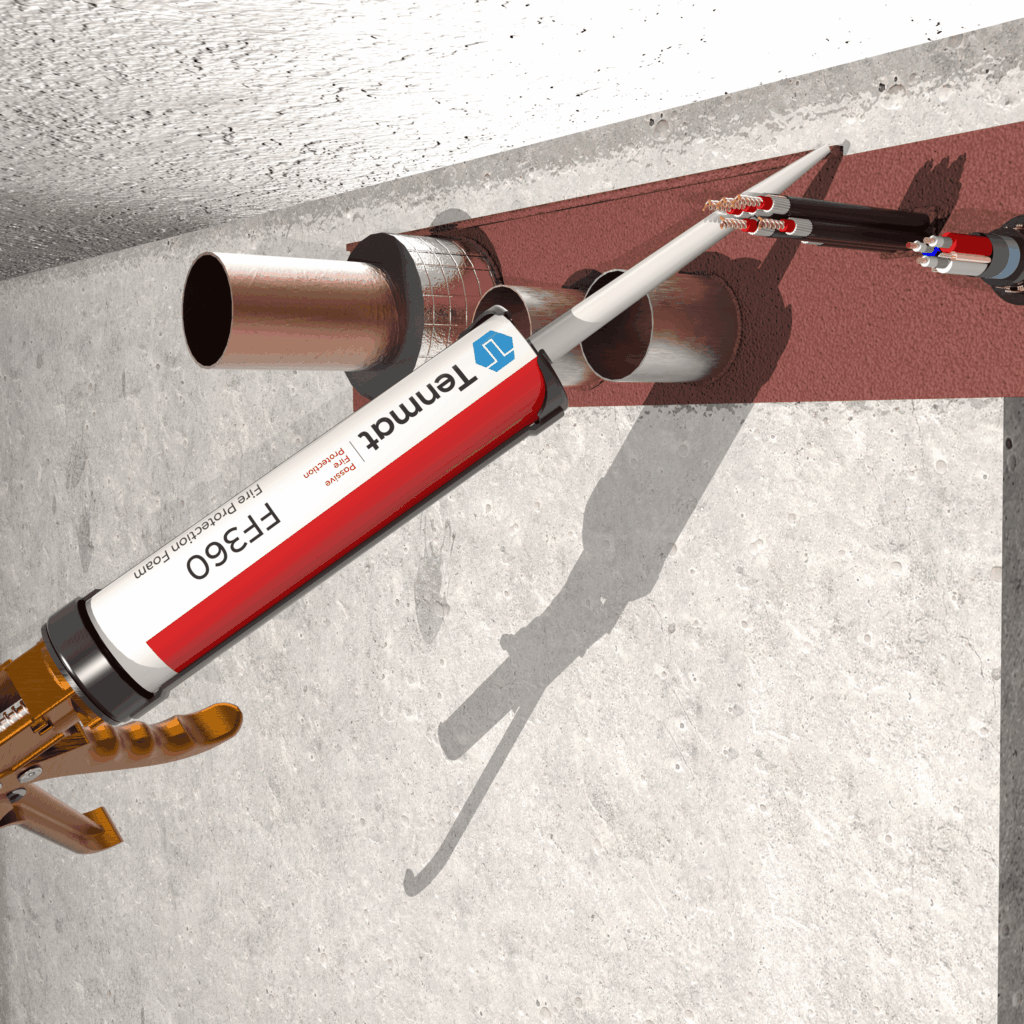
How to Install FF360 Firestop Foam
FF360 is supplied as a two-component cartridge requiring a 5:1 coaxial caulking gun. Installation is a straightforward four-step process. The full method is set out in the FF360 Installation Manual (link in the downloads block). The summary below is provided for specifiers and inspectors verifying the system has been installed correctly.
- Identify the correct UL Listed System for the substrate, penetrant and rating required.
- Prepare the opening. Clean off dust and grease. Install any required mineral wool backing or sleeves per the UL system drawing.
- Dispense FF360 through a 5:1 coaxial gun into the opening. The foam expands up to 5x and self-levels into irregular voids.
- Allow the foam to cure fully before inspection. Cured FF360 can be cut.
Retrofit is supported. Once cured, FF360 can be sliced cleanly with a utility knife to add or replace cables and re-foamed locally without compromising the wider firestop seal.
How to Install FF360 Firestop Foam
PRODUCT | BEST FOR | FORMAT | FIRE RATING |
|---|---|---|---|
FF360 Foam | Large, irregular, mixed-service penetrations | Two-component foam cartridge | Up to 2 hours |
FF365 Sealant | Small to medium, clean, single-service openings | Caulkable sealant | Up to 2 hours |
FF260 Block | Modular fire stopping, frequently retrofitted openings | Pre-formed intumescent block | Up to 2 hours |
FF160 Plug | Round, single-service penetrations (cables, conduit) | Pre-formed plug | Up to 2 hours |
Specifiers can combine FF360 with FF260 blocks or FF160 plugs for layered systems where individual cable bundles need encapsulating inside a larger foamed opening.
Standards, Approvals and Test Evidence
FF360 is UL Classified and tested in accordance with the following standards:
UL 1479: Standard for Fire Tests of Through-Penetration Firestops.
ASTM E814: Standard Test Method for Fire Tests of Penetration Firestop Systems.
Compliant with IBC Section 714 requirements for through-penetration firestopping in fire-rated assemblies.
Each FF360 UL Listed System provides an F-rating (time in hours the system prevents flame passage) and a T-rating (time the unexposed side stays below the heat transmission limit). Full system details, drawings and ratings are available through the UL Product iQ database. For supporting code background, see UL 1479 standard reference and ASTM E814 standard reference.
Commitment to Quality
TENMAT operates a Quality Management System which complies with the requirements of ISO 9001:2015 for the design, development and manufacture of specialized high-performance engineering
Leaders in Innovation
TENMAT’s ongoing commitment to the development of new products and solutions in the field of composite and engineering materials has been recognized in 2012, 2013 and 2019 by receiving the highest official award in Great Britain, the prestigious Queen’s Award for Enterprise in the categories Innovation and International Trade.

The International Building Code (IBC) Section 714 requires every through-penetration in a fire-rated wall, floor or ceiling to be sealed with a firestop system tested in accordance with either UL 1479 or ASTM E814.
TENMAT FF360 is UL classified and tested under multiple UL Listed Systems that comply with both standards. F-ratings and T-ratings for each system are listed on the FF360 product page and through the UL Product iQ database.
Specifiers and inspectors verifying IBC compliance should match the project requirement (rating, substrate, penetrant) to a specific FF360 UL Listed System. The FF360 Specification Text Section 16055 download provides ready-to-use spec language for electrical firestopping.
FF360 is a common specification choice in data center construction. The fire-rated walls separating server halls, electrical rooms and plenum spaces typically carry high-density cable trays passing between zones. FF360 encapsulates these bundles cleanly and seals the full opening up to 2 hours.
The key data center advantage is the flexible cured structure. Cable adds and moves are routine in operational data halls. With FF360, technicians can cut, route and re-foam in place without removing rigid blocks or replacing entire firestop installations.
TENMAT also supplies FF260 fire protection blocks and FF160 fire protection plugs for use alongside FF360 in layered penetration systems. See the TENMAT data centers application page for project examples and specification guidance.
FF360 firestop foam is dispensed from a two-component cartridge and expands up to 5x in volume during installation. It fills large, irregular openings and encapsulates dense bundles of cables and conduit efficiently. The foam stays flexible after cure for easy retrofit.
FF365 firestop sealant is a single-component caulkable sealant. It is applied with a standard caulking gun and is best suited to smaller, well-formed openings around individual pipes or conduit. It cures to a tough film.
Specifiers often combine the two on the same project: FF360 for the larger service shafts and cable tray penetrations, FF365 for the smaller, single-service openings where a caulked finish is cleaner and faster.
Retrofit is one of the design advantages of FF360 firestop foam. Unlike rigid intumescent systems, the cured foam stays flexible. Installers can use a utility knife to cut a clean opening, route the new cable or conduit through the existing firestop, and re-foam the affected area to restore the rated seal.
The local re-foam should be sized to fully encapsulate the new penetrant per the relevant UL Listed System. Documentation should be updated to reflect the change so future inspectors and building managers have an accurate record of the firestop configuration.
This retrofit-friendly behaviour makes FF360 a strong choice for data centers, telecom risers and any building where service additions are routine.
FF360 is supplied in a two-component cartridge with a static mixing nozzle. The only tool required is a 5:1 coaxial caulking gun, which applies even pressure to both components and feeds them through the mixing nozzle at the correct ratio.
No mixing buckets, paddles or separate metering equipment are required. The mixing happens inside the nozzle as the foam is dispensed.
Installers should also have personal protective equipment (gloves, eye protection), a utility knife for trimming cured foam, and the relevant UL Listed System drawing for the penetration being firestopped. The FF360 Safety Data Sheet covers full PPE requirements.
FF360 is formulated for fast installation. After dispensing through a 5:1 coaxial caulking gun, the foam expands up to 5x in volume and reaches a tack-free surface within minutes. Full cure depth is achieved within 24 hours at typical ambient temperatures.
Cure time can vary with temperature, humidity and the depth of the foamed opening. Cold or low-humidity conditions slow the reaction; warm humid conditions accelerate it.
Once fully cured, FF360 can be cut with a utility knife to expose individual cables for replacement, trimmed flush to the substrate for architectural finishing Refer to the FF360 Installation Manual for the full cure schedule and ambient condition guidance.
FF360 is engineered for through-penetration firestopping in fire-rated walls, floors and ceilings. Approved substrates include cast-in-place concrete, precast concrete, concrete block, brick masonry and gypsum board partitions.
Approved penetrants include single and bundled cables, cable trays, metal pipes, electrical metallic tubing (EMT), rigid metal conduit, mixed-service bundles, and blank openings where future services will be installed.
Typical application environments include data centers, healthcare facilities, multi-family residential construction, education buildings, hospitality projects and industrial plant rooms. The flexible cured foam allows additional cables to be added through the life of the building without breaking the firestop seal.
TENMAT FF360 carries fire ratings of up to 2 hours under UL 1479 and ASTM E814 testing.
Each UL Listed System for FF360 specifies an F-rating (the time in hours the system prevents flame passage) and a T-rating (the time the unexposed side remains below the heat transmission limit). Systems include C-AJ-0178, C-AJ-1744, C-AJ-3379, C-AJ-4116, C-AJ-5442, C-AJ-8319, C-AJ-8321, W-L-0061 and W-L-4103.
Specifiers should select the UL system that matches the substrate, penetrant configuration and required fire rating for the project. Full system drawings and ratings are available on the TENMAT FF360 product page and through the UL Product iQ database.
Standard polyurethane spray foam, including products marketed as ‘Great Stuff’ or generic gun foam, is an insulating material. It carries no fire rating and is not approved for firestopping fire-rated assemblies.
Firestop foam is a different chemistry. It is intumescent, which means it expands and chars when heated, forming a fire-resistant barrier. Firestop foams are tested to UL 1479 or ASTM E814 and listed under specific UL Listed Systems that detail the exact substrate, penetrant and configuration tested.
Using a non-rated spray foam in a fire-rated penetration is a code violation and creates a life-safety liability. Always specify a UL classified firestop foam such as TENMAT FF360 for through-penetrations in fire-rated walls, floors and ceilings.
Firestop foam is an intumescent sealant supplied as a two-component foam that cures into a flexible, fire-rated barrier. Under normal conditions the cured foam stays compact and flexible. When exposed to heat above 200 degrees C, the foam expands and chars, forming a dense insulating barrier that blocks flames, smoke and hot gases for the duration of the system’s fire rating.
Firestop foam is used wherever a service penetration (cable, conduit, pipe or duct) passes through a fire-rated assembly. The International Building Code (Section 714) requires every such penetration to be sealed with a system tested to UL 1479 or ASTM E814.
TENMAT FF360 is a UL classified firestop foam tested for through-penetration applications up to 2 hours.


