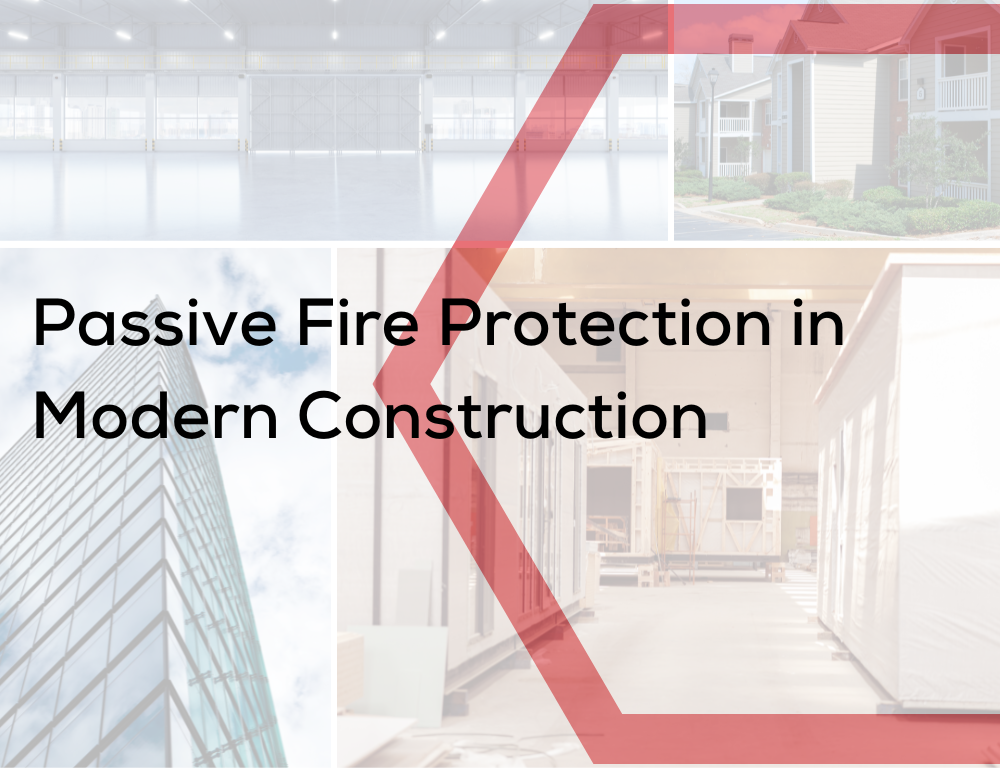
Learn More About the Standards of Passive Fire Protection in Modern Construction Practices.
Growing popularity for a major state university. Families relocating to the suburbs outside a rapidly developing city. Going demand for energy conservation practices in construction applications. For the past several decades, the United States has swiftly developed its cities and towns. Alongside the rapid development of our communities, so has the use of various construction techniques. Some of those techniques include off-site construction or the use of mass timber.
As these practices continue to develop, so should the specification of proper life safety measures. With the responsibility of protecting the lives and properties, passive fire protection should remain a vital component in modern construction. Therefore, building code professionals have been tasked with properly identifying the required firestopping solutions for each construction practice.
To allow for an easy transition, Tenmat has formulated an easy guide for building code and construction professionals. The guide below will provide an overview of modern construction applications and their associated passive fire protection requirements. Explore below and be proactive in protecting our communities from the disaster of a fire outbreak.
Advanced Passive Fire Protection in Audio Applications.
New JBL in-ceiling loudspeakers in your newly renovated home cinema? Mounting in-ceiling intercoms into new construction healthcare facilities? You and your team will be required to address the fire-rated ceilings you just penetrated.
When ceiling openings are left unprotected, flames, smoke, and heat are able to travel at an increased rate. Resulting in, the risk of endangering the lives and property within these infrastructures. To prevent this scenario, specify passive fire protection solutions designed to reinforce the integrity of the ceiling/floor assembly. Once installing a fire protection solution, such as Tenmat Fire-Rated Cover, the fire will be controlled.
A blend of sound isolation and passive fire protection, Tenmat’s FF109-FRSC is an ideal fire-rated solution for audio settings. A dome=shaped intumescent enclosure, the FF109 Speaker Cover reinforces the integrity of fire-resistance rated ceiling/floor assemblies. In normal conditions, the composition of the intumescent enclosure allows for an enhancement in the speaker’s acoustical performance. But, when a fire occurs, the intumescent material responds automatically to the high temperatures. By sealing off the ceiling opening completely, the fire is trapped into its original location.
Access Our Complete Passive Fire Protection for Audio Applications Here.
Passive Fire Protection in Data Centers.
In the Age of AI, power-storage and data centers play a pivotal role in today’s society. By managing, processing, and storing large volumes of important date, AI centers have become the community “brain”. These facilities boast a sophisticated design, incorporating multiple storage devices and optical storage to cater to diverse and high-level client demands.
Given the substantial volume of through-penetration wires and cables in these facilities, it is important to properly reinforce these unprotected openings. Tenmat has developed several UL Classified firestopping solutions to meet these specific demands. The FF160 Fire Protection Plug, a two-hour through-penetration firestop system, can be retrofitted within a wide range of settings. From power and control cables to optical fiber cables through solid floors or walls, the FF160 is applicable of properly fire rating these specific openings. The FF160 Intumescent Plug is UL Classified for a maximum of 60% cable fills in openings up to 5” diameter in concrete, this solution is easily customizable, making it ideal for power-generating energy stations.
Additionally, our FF260 Fire Protection Block, a preformed, intumescent firestop block, is formulated to seal penetrations with cables, cable trays, cable bundles, metal pipes, and mixed penetrations, ensuring flame spread and smoke are halted for 120 minutes.
Uncover the storage of information on Tenmat’s Advanced Intumescents for Data Centers.
Educating Building Professionals About Advanced Firestopping Solutions in Educational Institutions.
From pre-k to college-level, all educational buildings are the fountains of knowledge to our current and future generations. Fitted with fire-resistance rated assemblies, educational buildings take the extra step when it comes to protect the building and its occupants. Unfortunately, these fire-rated assemblies are compromised by the penetration of recessed light fixtures. Without the proper fire protection, these penetration openings are a prime pathway for flames, heat, and smoke.
One of the primary functions of passive fire protection is its capacity to save lives. In the unfortunate event of a fire outbreak, passive fire protection, such as fire-resistant materials and solutions, act as a barrier. How?
By containing the spread of flames and heat, passive fire protection pushes the fire to stay in its origin of location. As opposed to the fire escaping through penetration openings, passive fire protection cuts off the fire’s access to the remaining parts of the building. This cutoff permits additional response time towards a fire. With the additional time for evacuation procedures to take place, the level safety for students and staff increases.
Fire-Rated Solutions for Troffer Luminaires
Normally fitted with T-bar ceilings, educational facilities require a fire-rated solution to fit into this ceiling type. To align with the industry’s norm of suspended “T-Bar” ceilings, Tenmat engineered its fire-rated troffers. Tenmat’s FF130 – 2’ x 2’ and FF130 – 2’x4’ – are UL one-hour, fire-rated enclosures designed to fit over troffer luminaires in T-bar suspended ceilings.
With its ability to cater to any luminaire, regardless of any model or/and manufacturer, the FF130 Fire-Rated Troffers allow for architects and developers to choose their preferred lighting choice. Additionally, the flexible and lightweight nature of these covers allows for installation quickly and easily. Therefore, significantly reducing labor costs compared to other traditional fire protection methods.
Explore Our Education Page to Educate Yourself on Fire Protection in Educational Buildings.
Managing Moisture Management and Air Ventilation in Ventilated Rainscreen Assemblies
Known for its purpose of increasing a building’s efficiency, the use of ventilated rainscreens has saturated the construction landscape. And an added plus? Architects are able to curate sleek and modern architectural designs with the use of cladding and facade systems. However, this innovative practice does have its challenges. One of the most concerning challenges is the air cavity residing between the cladding and the exterior sheathing. In normal conditions, the air cavity acts as the primary function for proper air ventilation and moisture management.
While this design strategy brings about notable advantages in terms of energy conservation and thermal performance, it also introduces a significant life safety challenge that demands careful consideration. The resulting void functions as an open chimney, posing a serious threat to the building’s structural integrity and the safety of its occupants. In the event of a fire this void becomes a conduit, allowing flames to spread rapidly both vertically and horizontally throughout the building.
Addressing Section 718.2.6 of the IBC
Building code professionals have addressed this safety issue in Section 718.2.6 Exterior Wall Coverings of the IBC. In this section of the code, it identifies how architects need to address this life safety hazard. This is done by specifying fireblocking throughout the ventilated air cavity. Unfortunately, the fireblocking negatively impacts the performance of the rainscreen system. By fully blocking the cavity, moisture management and air circulation are unable to perform at full capacity. Therefore, defeating the purpose of incorporating a ventilated facade assembly.
To find the balance of compliance and performance, Tenmat curated a solution where it only blocks off the cavity when it matters most. In normal conditions, Tenmat’s Intumescent Fire Blocks allows for a 1.75″ open space. This permits the flow of air circulation and water management – unlike other traditional fireblocking. However, when exposed to high temperatures, the Intumescent Blocks rapidly expand across the cavity – sealing the cavity off from flames and high temperatures.
Discover how Intumescent Fire Blocks have altered the standards in performance and compliance in the facade industry.
A Band-Aid Won’t Fix These Unprotected Openings
Serving as an essential hub for healing and wellness, healthcare facilities are our community’s main function. Hosting individuals who have limited mobility, the danger of fire is at an all-time high. With its occupants needing additional time to evacuate, the presence of passive fire protection is critical.
From top to bottom, healthcare facilities are teeming with unprotected openings. With countless lighting fixtures and wires running through these assemblies, construction teams are tasked with reinforcing these openings.
With the ceiling assemblies being either suspended or a “T-Bar” design, TENMAT has formulated the FF130-2’x2’ and FF130 – 2’x4’, a fire rated enclosure designed for troffer luminaires. In addition to demanding fire protection for unprotected ceiling openings, hospitals often require a higher fire rating for its assemblies.
Equipped with large-scale sanitary drainage and electrical wiring systems, through-penetration is another key opening for flames and smoke. As a result, Tenmat offers a full line of fire-rate solutions, designed for the small, irregular openings for through-penetration applications. Tenmat’s FF160 Fire Plug is a flexible and lightweight solution. This advanced intumescent is ideal for retrofitting installations, as well as new construction of power and control cables, telecommunication cables, and optical fiber cables through sold floors or ceiling systems.
Rip off the bandage and discover more about passive fire protection in healthcare facilities.
Shopping for Life Safety? Passive Fire Protection in Hospitality
Whether you are developing a new shopping mall or all-inclusive resort, the presence of passive fire protection is required. By hosting large volumes of people on a daily basis, the threat of a fire needs to be contained. Why? To ensure all its occupants and the property will have enough response to evacuate and control the fire outbreak.
Passive fire protection systems, such as TENMAT’s intumescent materials and solutions, serve as the first line of defense. Tenmat’s Advanced Intumescents allows for more time to evacuate and minimize property damage. These solutions do not only protect the lives of guests and staff. They also allow for minimal property damage – allowing for faster rebuild times.
By incorporating fire-rated solutions in fire-resistance assemblies, one of the largest life safety hazards is resolved. Unprotected Ceiling Openings. With our pre-designed intumescent covers, Tenmat’s Fire-Rated Covers reinforce the compromised integrity of fire-resistance ceiling assemblies.
Explore Tenmat’s Advanced Intumescents in Hospitality Applications.
Implementing Firestopping Technology in Industrial and Commercial Applications
Developing a state-of-the-art manufacturing facility? Building additional warehouses for consumer giants, such as Amazon? It’s important to address the life safety hazards you may have left unprotected.
In the unfortunate event of a fire, the lives of the employees and the physical assets of the facility are in danger. By integrating passive fire protection, this danger will be voided. Passive fire protection provides additional time for building occupants to evacuate, and an increased response time for first responders to extinguish the fire outbreak.
Many of these applications have irregular, hard-to-access, and/or small penetrations, which poses a threat when an outbreak of a fire occurs. These small, irregular openings allow for the flames, heat, and smoke to travel faster within a building. Thereby, threatening lives and property damage above average levels.
In response, Tenmat has formulated a line of pre-made solutions that cater to these irregular, hard-to-access openings. Tested and approved to protect these types of openings, Tenmat can confidently say our advanced intumescents will protect lives and properties for up to two hours.
Review how our Advanced Intumescent Materials and Solutions operate in an industrial or commercial environment.
Master the Trade of Mass Timber and Passive Fire Protection Technology.
Categorized of engineered wood products, mass timber has become adopted construction technique in minimizing one’s carbon footprint. Typically made of large, solid wood panels or beams, mass timber solutions offer sustainability, design flexibility, efficiency, and structural performance.
For joint and gap sealing applications in mass timber, cross-laminated timber (CLT), and glulam, Tenmat has developed a line of state-of-the-art intumescent materials and solutions. Each firestopping solution has been designed with the capability to be versatile in various applications. Tenmat’s FIREFLY 107 is an exceptionally powerful intumescent which combines fast reaction with high expansion and pressure generation. The FF107 produces a solid char of good integrity. With its composition, the FF107 is applicable in construction joints and gaps. If the application requires a highly flexible firestopping material, Tenmat’s Firefly 104E is the optimal solution. With its flexible nature, the FF104E is applied into door and glazing seals, door hardware and ironmongery protection, damper seals, gap sealing or a variety of gasketing applications.
Interested in seeing our Advanced Intumescents installed into Mass Timber Applications? Click here.
Exploring the Demand for Fire Protection in Off-Site Construction.
Over the past several years, there has been a sharp increase in demand for more effective and efficient building processes. This heightened demand primarily stems from the limitations associated with traditional construction practices. These issues are related to safety, construction quality, and project timelines. The answer? Modular or off-site construction.
Modular, or off-site, construction practices have an assortment of benefits. However, the demand for passive fire protection is equivalent to its demands in traditional construction practices. By integrating passive fire protection at the point of manufacture, off-site structures fitted with fire protection prior to its arrival at the construction site. With that being said, this act allows for a decrease in last minute installations of fire protection – eliminating out of budget costs.
From edge protection to through penetration, Tenmat offers “no build” UL fire-tested solutions. These UL solutions have the ability to be installed in a matter of seconds. While still offering the flexibility to cater to the most difficult openings with no additional assembly or tools. Tenmat’s Firefly FF107 is an exceptionally powerful intumescent which combines fast reaction with high expansion and pressure generation. This material allows for an additional thickness for construction joint and gap sealing applications where the high expansion characteristics lead to economical material usage. If you are seeking to fire rate smaller wall penetrations, Tenmat offers a fire protection foam, the FF360. This sealant is recommended for blank openings, metal pipes, conduits, wires, and mixed penetrations in solid floors and ceilings.
To become an expert about passive fire protection standards in modular construction, please visit Modular Sector Page.
Advanced Intumescent Solutions and Materials in Multifamily
Adopting present-day energy efficiency standards, many architects have gravitated towards using Type V-A for new-construction multifamily. With its material composition, Type V-A provides excellent design flexibility. This allows for diverse architectural styles and layouts, making this practice optimal for residents, developers, and architects. Common applications of Type V-A construction include apartment complexes and condominiums. These structures house a multitude of families and individuals. Therefore, heightening the importance of installing passive fire protection solutions. By containing smoke and flames, it permits an extended response time. Whether it’s extinguishing the fire itself or prolonging the evacuation time, fire protection protects lives and properties within these facilities.
One of the number one causes for the rapid acceleration of a fire is its compromised ceiling/floor assembly. When penetrated by recessed can lights, LED downlights, or in-ceiling loudspeakers, the ceiling’s fire rating is compromised. Once a fire begins, the composition of the in-ceiling fixture melts within 15 minutes. This allows for heat, flames, and smoke to travel at a swift pace throughout the structure. In response, Tenmat has created a line of fire-rated enclosures. Designed to fit over standard recessed can lights, oversized can lights, LED downlights, and in-ceiling speakers, Tenmat’s Fire-Rated Covers eliminates the hazard of a compromised ceiling.
Learn more about how Tenmat’s Fire-Rated Covers operate in a multifamily application.
Wrapping It Up
Today or in the future, it is important to protect our communities from overlooked safety hazards. Whether if the opening is in the ceiling or wall, Tenmat offers a tested and approved fire-rated solution. From through-penetration to troffer luminaires, we address every possible unprotected opening.
To learn more about our full catalogue, please visit Application Overview or contact one of our specialists at +1-800-821-3436.