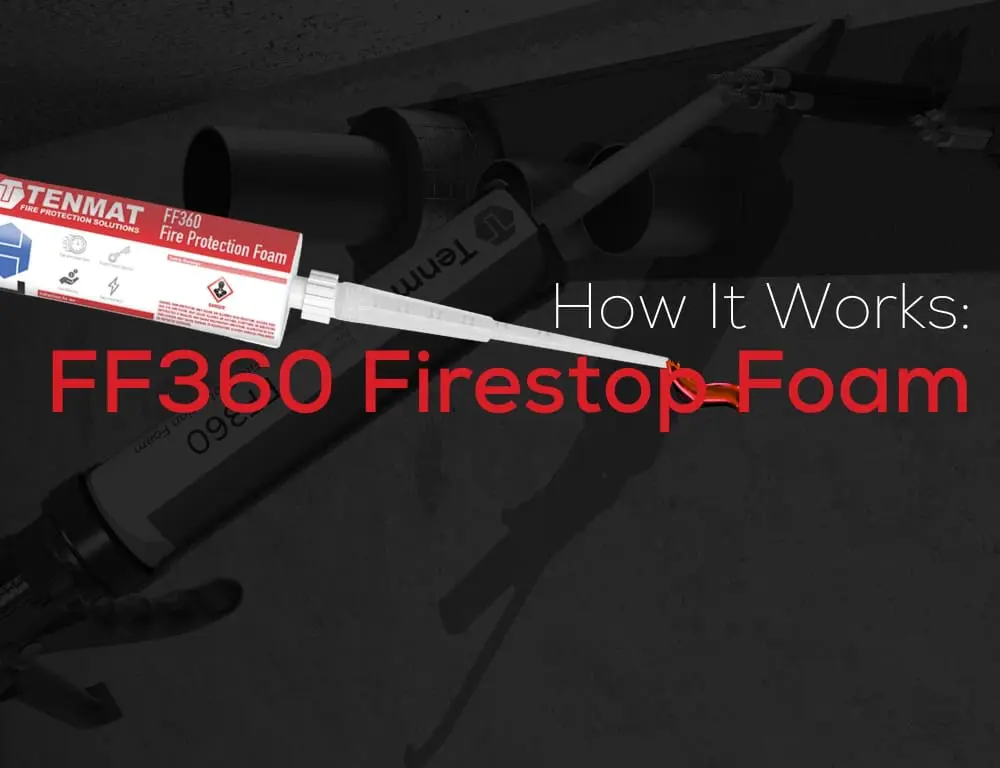
A firestop sealant is a specialized product applied around pipes, conduits, cables, and other penetrations that pass through fire-rated walls, floors, and ceilings. Its job is to seal the gap so that flames, heat, and smoke can’t travel through a fire-rated assembly from one compartment to another.
You’ll also see these products searched for as “fire caulk,” “fire caulking,” “firestop caulk,” or “fireproof caulk.” Those terms are common on site, but they aren’t precise. A caulk is a gap-filling compound for weatherproofing and joints. A firestop sealant is a tested, fire-rated product with a very different job, so the two aren’t interchangeable, and no sealant is genuinely fireproof. The accurate term for the product this guide covers is firestop sealant, or fire-resistant sealant. We use that throughout and mention the caulk terms only because that’s what people often type into search.
A firestop sealant is not an ordinary caulk. Standard silicone or latex caulk provides no fire resistance. Only products tested and listed under recognized fire standards such as UL 1479 (ASTM E814) qualify as firestop sealants.
How Firestop Sealants Work
Most firestop sealants use intumescent chemistry. At ambient temperatures, the sealant behaves like any gun-grade caulk: flexible, adhesive, and easily applied. When exposed to heat above approximately 400°F (200°C), the intumescent material expands, sometimes up to several times its original volume.
That expansion closes the penetration opening around the pipe or cable, cutting off the path for flames and smoke. It also provides insulation, slowing heat transfer through the assembly.
The performance standard for through-penetration firestop systems in the US is UL 1479, also published as ASTM E814. Firestop sealants are tested for fire resistance (F rating), heat transmission (T rating), and smoke resistance (L rating). A 2-hour F/T rating means the system prevents flame passage and limits heat transfer for two full hours. Without a valid listed system, no firestop sealant satisfies code.
Types of Firestop Sealant
Not all firestop sealants are the same. Choosing the right type depends on the substrate, the penetrant material, and the required fire rating.
Intumescent vs. Non-Intumescent
Intumescent firestop sealant expands on contact with heat, making it suitable for penetrations where the pipe or cable may melt or burn during a fire. The expansion fills the void left behind. Non-intumescent sealants rely on their material properties to resist flame and smoke. They work in static, non-combustible penetration scenarios but won’t compensate for a melted plastic pipe.
Water-Based vs. Solvent-Based
Water-based firestop sealants are easier to apply and clean up, paintable, and lower in VOCs. They’re the most common choice for interior through-penetration applications. Solvent-based products offer better adhesion in wet or cold conditions but require more care in handling and disposal.
Gun-Grade vs. Trowel-Grade
Gun-grade firestop sealant is applied using a standard caulking gun, with cartridges typically around 10.5 oz. This makes it the practical choice for small to medium penetrations: conduits, single cables, and small pipes. Trowel-grade firestop sealant is applied by hand or spatula and suits larger openings or irregular surfaces.
Fire Ratings
Firestop sealant is available in 1-hour and 2-hour ratings, corresponding to the fire-resistance rating of the assembly being sealed. Always match the sealant’s listed system rating to the assembly rating. A 1-hour listed sealant in a 2-hour rated wall does not meet code.
Where Firestop Sealants Are Used
Firestop sealant is required across commercial, residential, and industrial construction. Any time a service penetrates a fire-rated barrier, that penetration must be sealed.
Through-Penetration Firestopping
This is the primary application. Pipes, electrical conduits, data cables, HVAC ducts, and mixed penetrations all require firestopping where they pass through a rated floor, ceiling, or wall. Firestop sealant is applied into the annular space between the penetrant and the surrounding substrate to form a complete seal.
Blank Openings
Oversized sleeves or unused openings in rated assemblies require sealing. Gun-grade firestop sealant handles smaller blank openings; larger gaps may need a combination of backing material and sealant.
Head-of-Wall Joints
The joint between the top of a partition wall and the underside of the floor or roof deck above is a common fire pathway. Firestop sealant applied in a continuous bead closes this linear gap.
Construction Joints
Seismic, expansion, and perimeter joints in rated assemblies require firestopping systems that accommodate movement while maintaining the fire barrier. Flexible firestop sealant formulations are often specified here.
Typical Building Types
- Multi-family residential: apartments, student housing, senior living
- Healthcare facilities and hospitals
- Hotels and hospitality
- Educational buildings
- Data centers and commercial offices
- Industrial and manufacturing facilities
Building Code Requirements for Firestop Sealants
Firestop sealant is required by code in fire-rated construction. Every penetration through a rated assembly must be protected by a listed firestop system.
International Building Code (IBC)
IBC Section 714 governs through-penetration firestop systems. It requires that penetrations in fire-resistance-rated walls and floor-ceiling assemblies be protected using listed and labeled assemblies tested to the F rating requirements of ASTM E814 or UL 1479. The system must carry an F rating matching or exceeding the assembly’s required rating.
NFPA 101 (Life Safety Code)
NFPA 101 applies in occupancies where the Life Safety Code governs, including healthcare and certain educational buildings. It carries equivalent requirements for penetration firestopping in rated barriers.
The Listed System Requirement
A critical point: you can’t simply apply any sealant to any penetration and call it code-compliant. The product must be installed as part of a listed firestop system: a specific combination of substrate, penetrant type, annular space dimensions, and sealant depth that has been tested and certified together.
Always verify that your chosen product has a UL-listed system covering the specific substrate (concrete floor, gypsum wall), penetrant type (steel pipe, plastic conduit, cable bundle), and opening size. The product alone does not create compliance. The listed system does.
Who Enforces Compliance?
Building inspectors, fire marshals, and the Authority Having Jurisdiction (AHJ) verify that firestopping is installed correctly before a building passes inspection. Missed or improperly installed penetrations are a common code deficiency that can delay occupancy permits.
Firestop Sealant vs. Firestop Foam: What’s the Difference?
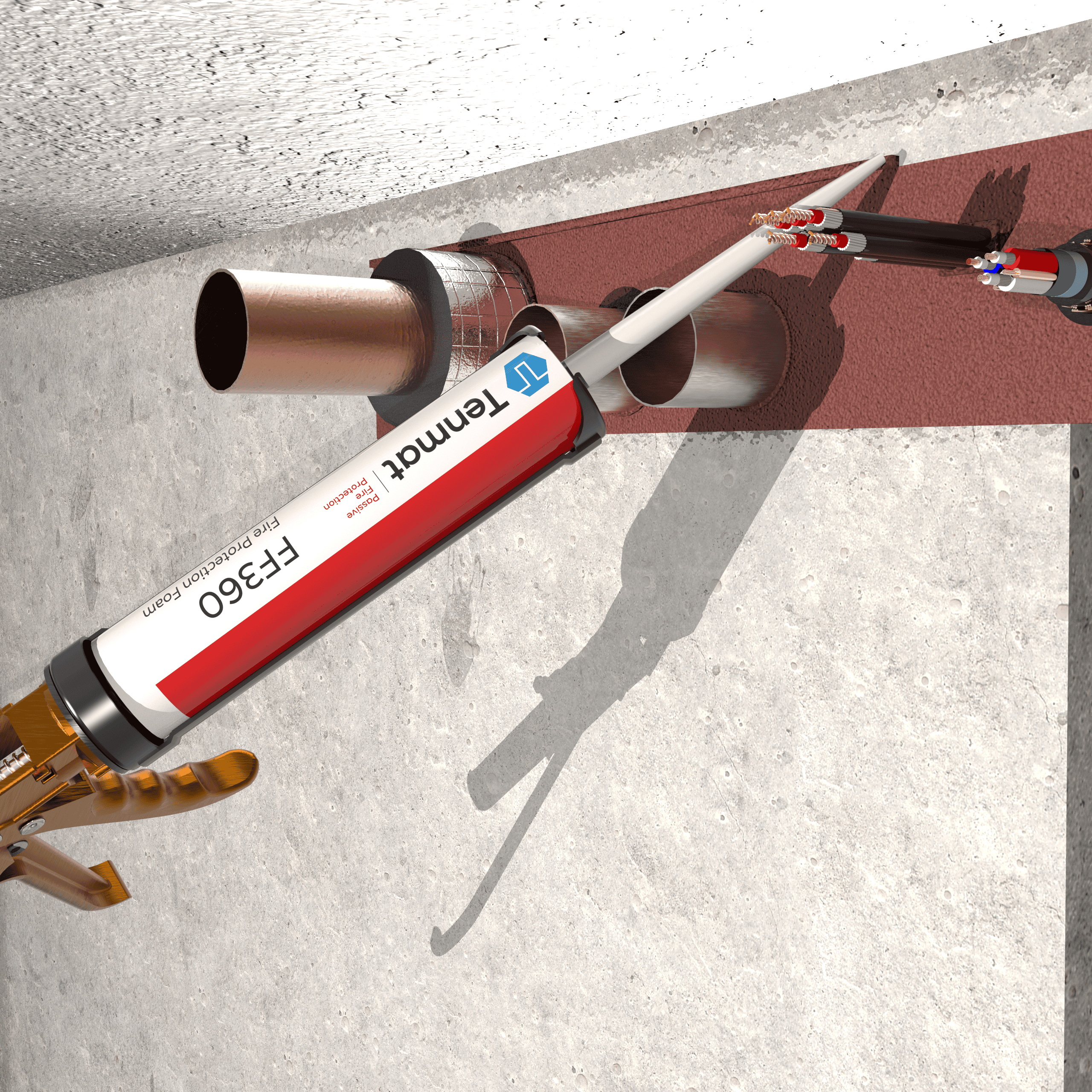
Contractors frequently ask whether to use a firestop sealant or firestop foam. Both are intumescent, both are UL-listable, and both stop flames and smoke. The differences are in form factor, application method, and the penetrations each handles best. You’ll sometimes see “fire caulk” used loosely to mean either product. In practice it almost always refers to a gun-grade firestop sealant rather than foam.
| Firestop sealant | Firestop foam | |
|---|---|---|
| Form | Gun-grade cartridge (10 oz.) | Two-component expanding foam canister |
| Best for | Small/medium penetrations, precise placement | Large, irregular, or hard-to-reach openings |
| Penetrant types | Single pipes, conduits, cables, wires | Cable trays, mixed bundles, oversized openings |
| Application tool | Standard caulking gun | Coaxial mixing gun (5:1 ratio) |
| After cure | Cables can be added without cutting | No cutting required to add cables |
| Paintable | Yes (water-based) | Yes (water-based) |
| Fire rating | Up to 2 hours (UL 1479) | Up to 2 hours (UL 1479) |
| Expansion | Expands in fire to close void | Expands 5x on application; re-expands in fire |
As a general rule: use a firestop sealant for smaller, more precise applications where you need clean, controlled placement. Use firestop foam when dealing with large, irregular openings, cable trays, or penetrations that are hard to access.
In practice, the two products are often used together on the same project: firestop sealant for conduit and pipe penetrations, foam for cable tray openings.
Tenmat USA Firestop Sealant Solutions
Tenmat USA offers both a gun-grade firestop sealant and a firestop foam. Both are UL Classified and tested to UL 1479 and ASTM E814 for 2-hour through-penetration protection.
FF365 Fire Protection Sealant
The FF365 is Tenmat’s gun-grade firestop sealant: a one-component, water-based, intumescent product in a standard 10.48 fl. oz. cartridge, compatible with any conventional caulking gun. It’s the right choice when you need a precise, gun-applied seal around conduits, pipes, and cable penetrations in gypsum or concrete assemblies.
- UL Classified | 2-hour F/T rating (UL 1479 / ASTM E814)
- Intumescent: expands in a fire to seal the penetration void
- Sag-resistant for clean vertical and overhead application
- Paintable and water-based for easy cleanup
- Flexible after cure: additional cables can be added without cutting
- Suitable for blank openings, metal pipes, conduits, wires, and mixed penetrations in solid floors and ceilings
- Seven UL listed systems: C-AJ-0178, C-AJ-0179, C-AJ-1745, C-AJ-3377, C-AJ-3378, C-AJ-4117, C-AJ-8320
FF360 Fire Protection Foam
Where the FF365 handles smaller, precise work, the FF360 handles larger jobs. It’s a two-component, intumescent foam that expands up to 5x during installation, ideal for irregular openings, cable trays, and penetrations where a gun-grade sealant can’t reach every gap.
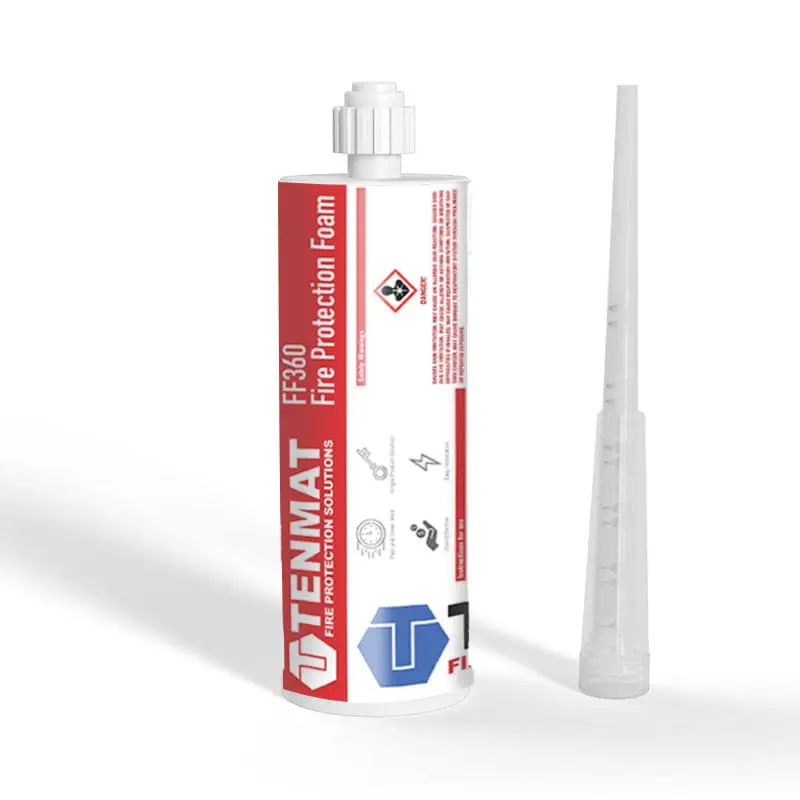
- UL Classified | 2-hour protection (UL 1479 / ASTM E814)
- Expands 5x in volume during application for thorough gap coverage
- Suitable for blank openings, cable trays, and mixed penetrations
- Nine UL listed systems covering wall and ceiling/floor assemblies
- Flexible after cure: retrofitting new cables requires no special tools
Need Firestop Sealant for Your Project?
Tenmat USA supplies UL-listed firestop sealant and foam for contractors, builders, and specifiers across the US and Canada. Products typically ship within 24 hours.
Frequently Asked Questions
Question 1: Is fire caulk the same as regular caulk?
Regular caulk and firestop sealant look similar in the tube but serve completely different purposes. Standard silicone, latex, and acrylic caulks are designed for weatherproofing, flexibility, or adhesion. They have no fire-resistance properties and will fail quickly in a fire.
A firestop sealant, sometimes called “fire caulk” or “fireproof caulk,” is formulated with intumescent chemistry. When exposed to heat above approximately 400°F (200°C), the material expands, sealing the penetration to prevent the passage of flames and smoke. To be used in a code-compliant installation, the product must be tested and listed as part of a firestop system under UL 1479 / ASTM E814.
Each listed system specifies a precise combination of substrate, penetrant type, annular space, and sealant depth. The product alone is not sufficient, the listed system is what creates compliance. You can check listed systems in the UL Product iQ database.
Question 2: How long does firestop sealant last?
Listed firestop sealants are designed to last the service life of the building. Once cured in a correctly installed listed system, there is no scheduled replacement or periodic maintenance required under IBC or NFPA requirements.
The caveat is disturbance. Any time a penetration is modified, a new cable pulled through, a pipe replaced, or the opening altered in any way, the original firestop system is compromised. The penetration must be re-sealed using a listed system before the assembly is closed and before inspection.
This is a common oversight on renovation and retrofit projects, where contractors may pull new cable through an existing sealed penetration without reinstating the firestop. IBC Section 714 requires that any modification to a rated assembly maintain the assembly’s fire-resistance rating, which includes restoring all firestop systems.
For product-specific cure times and long-term performance data, refer to the FF365 Fire Protection Sealant product page.
Question 3: Can firestop sealant be painted?
Whether a firestop sealant can be painted depends on its formulation. Water-based firestop sealants, the most common type for interior through-penetration applications, are generally paintable once cured. Solvent-based products may not be compatible with standard paints, so always verify with the product’s technical data sheet before painting.
Paintability matters on projects where firestopped penetrations are visible in finished spaces: corridor walls in healthcare facilities, stairwells, or multifamily residential units. A sealant that can be painted matches the surrounding finish and reduces the visibility of the penetration.
The Tenmat FF365 Fire Protection Sealant is water-based and paintable after cure. It cures to a smooth, sag-resistant finish suitable for vertical and overhead applications. Check the FF365 technical data sheet for recommended cure time before painting.
Question 4: Who installs firestop sealant?
Responsibility for firestop sealant installation depends on how the project is contracted. On most commercial and multifamily projects, firestopping is carried out by whichever trade made the penetration: electricians seal cable and conduit penetrations; plumbers seal pipe penetrations. On larger or more complex projects, a dedicated firestop contractor handles all penetration sealing as a separate scope.
Regardless of who does the work, the installer must follow the listed system requirements for the specific combination of substrate, penetrant, and opening size. The product must be applied at the correct depth and within the annular space limits of the listed system. Any deviation from the tested configuration can compromise the fire performance.
Question 5: What’s the annular space limit for a firestop sealant?
The annular space is the gap between the penetrating item (pipe, conduit, or cable) and the edge of the opening in the wall or floor assembly. Each UL listed firestop system specifies the maximum annular space the product can reliably seal. These limits vary by penetrant type, substrate, and sealant depth.
For a gun-grade firestop sealant, annular space limits typically fall in the range of 1/4 inch to 2 inches, depending on the listed system. Larger openings may require backing material, mineral wool, for example, installed first, with the sealant applied over it to the required depth.
Always check the listed system documentation before application. Using the right product in the wrong configuration, wrong annular space, insufficient sealant depth, does not produce a compliant installation. All listed systems are searchable in the UL Product iQ database.
For the annular space parameters covered by Tenmat’s listed systems, refer to the FF365 Fire Protection Sealant product page.
Question 6: What’s the difference between an F rating and a T rating?
When a firestop system is tested under UL 1479 / ASTM E814, it is assigned two primary performance ratings.
The F rating (Flame) measures how long the system prevents flames and hot gases from passing through the penetration. An F-2 rating means the system resists flame passage for two full hours under test conditions.
The T rating (Temperature) measures thermal insulation performance. It tracks how long the system limits the temperature rise on the unexposed side of the assembly to no more than 325°F (163°C) above ambient. The T rating matters most in applications where combustible materials may be present on the other side of the wall or floor.