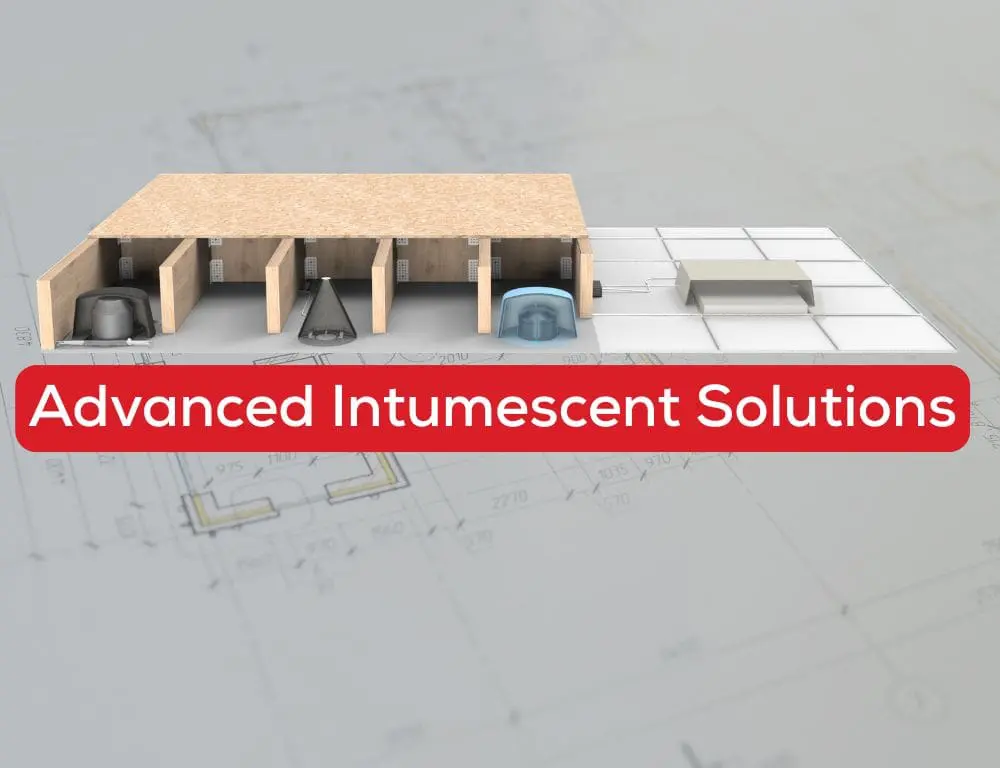
Explore how Tenmat’s Advanced Intumescent Solutions exceed the standards for passive fire protection in a wide range of construction applications
Adding Advanced Intumescents into Modern-Day Construction
Over the past several decades, the adoption of passive fire protection requirements has spread like wildfire throughout the United States. From reinforcing unprotected openings in ceilings, floors, walls – and even in exterior air cavities, building code officials have pushed towards addressing these life safety hazards.
By now requiring passive fire protection in a diverse range of construction applications, construction professionals are now seeking passive fire protection solutions and materials to fulfill these standards. To meet these demands, an explosion of passive fire protection solutions and materials occurred.
Introduction to Intumescents
Introducing various passive fire protection materials and solutions, varying in material composition and dimensions, construction professionals now face the challenge of finding a properly tested fire-rated solution to fit into their project specifications.
By understanding the importance of these standards, you and your project team will be able to navigate through the decision-making process of selecting the proper passive fire protection in your construction application. Let’s begin.
How has intumescent fireblocking changed the NYC landscape?
In 2022, the NYC Building Code adopted several building code requirements – more specifically around fireblocking in exterior wall coverings. These adoptions caused quite a commotion – due to its very strict parameters on combustible cladding. Many architects and builders deemed using certain cladding and other building materials “illegal” in New York City. However, this assumption is false. Architects and contractors are very much able to install combustible systems into New York City – however, there are just a few extra steps.
Any cladding system which houses a combustible component (no matter how small) requires an approved fireblocking solution. Please note there are additional requirements for fireblocking in exterior wall cavities. Refer to the 2022 NYC Building Code Here.
But one thing is clear – fireblocking is required in exterior wall assemblies in New York City. To meet these requirements, architects started specifying mineral wool and other traditional fireblocking materials into the exterior air cavity. Unfortunately, the installation of these types of solutions limited the performance of the air cavity. Why?
Fireblocking is required to extend across the entirety of the cavity – which traditional fireblocking fulfills. With this blockage occurring during normal conditions, the air cavity will be unable to properly circulate air and drain water. These implications defeat the purpose of integrating a ventilated rainscreen assembly.
In response to this challenge, Tenmat introduce a fireblocking technology that can allow for an open-state air cavity in normal conditions– intumescent fireblocking. In normal conditions, Tenmat’s Intumescent Fireblocking permits an air gap – allowing for proper ventilation and moisture control. However, in the event of a fire, the intumescing material rapidly expands – sealing off the rest of the cavity from flames, smoke, and heat.
To learn more about intumescent fireblocking, check out our information page here.
Why are intumescents ideal for through-penetration applications in data centers?
By installing an intumescent firestopping solution, architects and contractors can easily meet firestopping requirements while not compromising the structure of the data center.
Rapidly becoming one of the most popular project types in the United States, data centers are on every professional’s radar. With that being said, data centers house thousands of wires and cables in their walls, ceilings, and walls.
Like any other construction applications, any time an opening is created through a fire-rated assembly – the application needs to be reinforced with a proper firestopping solution.
In the case of a fire outbreak, it is important that the fire is compartmentalized and not spreading rapidly throughout the building. However, when an opening is left unprotected – property and lives are jeopardized. But a small wire hole cannot be the main access point for a fire – right? Wrong.
If these holes aren’t properly firestop, flames, heat, and smoke can easily gain access to the remainder of the building. In just several moments, the high temperatures and flames easily melt the wires and cables in your walls, ceilings, and floors. Once melted, these openings have no barrier between the fire and the rest of the building. To interrupt this interaction, building code officials issued a requirement for a fire-rated solution for these through-penetration applications.
Tenmat and Through-Penetrations
Tenmat has formulated several UL Classified firestopping solutions to accommodate these demands. The FF160 Fire Protection Plug is a two-hour through-penetration firestop system with the ability to be retrofitted within power and control cables, telecommunications cables, and optical fiber cables through solid floors or systems. This solution is UL Classified for a maximum of 60% cable fills in openings of max. 5” diameter in concrete and can be easily cut to pass wires or cables through them – ideal for power-generating energy stations.
At Tenmat, we also offer the FF260 Fire Protection Block, a preformed, intumescent firestop block – formulated to assist in sealing penetrations with cables, cable trays, cable bundles, metal pipes, and mixed penetrations. With its high expansion and insulating properties, the FF260 Fire Protection Block ensures that both flame spread and smoke are stopped for 120 minutes.
If you are interested in viewing the full product range for data center applications, click here.
What technologies are used to properly fire rate in-ceiling loudspeakers in higher education facilities?
Just like any recessed fixture installed into a fire-resistance rated assembly, the opening needs to incorporate an approved fire-rated solution. Commonly, higher education lecture halls are fitted with audio systems, which include in-ceiling loudspeakers. By installing in-ceiling loudspeakers, your hired contractor is highly likely penetrating a fire-resistance rated assembly.
With this penetration, the ceiling assembly is now compromised. Therefore, a fire-rated solution is required.
To permit the usage of any preferred speaker manufacturer and/or brand, Tenmat offers the FF109-FRSC – a fire-rated speaker enclosure. By simply placing this cover over an in-ceiling loudspeaker, you will no longer be compromising design nor compliance. Formulated to meet a wide range of in-ceiling loudspeaker designs, Tenmat’s FF109-FRSC is a great solution for both design and compliance purposes.
Explore more about the FF109-FRSC Fire-Rated Speaker Cover.
Which fire-rated solutions are used to protect ceiling openings in new construction multi-family?
Tenmat’s FF109 LED Downlight Fire-Rated Covers is one of the few tested and approved fire-rated solutions on the market for multi-family applications. Undergoing proper testing and approvals by third-party laboratories, such as UL and Intertek, Tenmat LED Downlight Fire-Rated Covers are compliant with multi-family applications.
One of the recent challenges of passive fire protection and multi-family applications is that many fire-rated solutions claim to have undergone proper tests; however, this is not the case. These “testing claims” are not back by any testing data. In fact, these claims are only backed by the individual components deemed fire-resistant by their own individual testing. But, for a solution to be complaint – it needs to go under proper testing and certifications.
To view our testing and certifications, please visit here.
How do I reinstate two-hour fire-rated ceilings with unprotected openings?
By incorporating a two-hour fire-rated solution, such as Tenmat’s FF109X, contractors can easily reinstate the integrity of two-hour fire-resistance rated ceiling assemblies. Often in healthcare facilities, such as assisted living and rehabilitation centers, these infrastructures require a higher fire rating for ceiling/floor assemblies. Therefore, you’ll need to integrate a fire-rated solution that provides the same rating.
One of the main challenges that come with this scenario is lighting. In healthcare facilities, the building’s operations require a higher lumen output to ensure proper treatment and care is provided to its patients. Other solutions, such as fire-rated lights, often cannot fulfill this requirement. Designed to accommodate a wide range of applications and lighting fixtures, Tenmat’s FF109X permits architects to specify lighting with the proper lumen output while meeting fire protection standards.
Discover how the FF109-X Fire Rated Light Cover will fit into your details
Final Thoughts
At Tenmat USA, we provide a broad range of advanced intumescent solutions and materials for many construction applications. Whether you need to firestop through-penetrations in data centers or protect downlights in multifamily projects, we offer tested, approved solutions.
We also recognize that some applications require a solution beyond our standard product range. With our onsite R&D team and manufacturing capabilities, we are open to creating a fire-rated solution customized to your application. Interested? Please contact our team for assistance.