Explore how architects and design specialists are finding the balance between performance and stringent fireblocking requirements in exterior wall assemblies.
In today’s construction landscape, building professionals have adopted a wide range of different construction practices. However, façade applications fixed with an exterior wall assembly have become an increasingly popular practice over the past several years.
With its ability to meet ongoing federal energy efficiency standards, exterior wall assemblies have become an easy fix all for architects and specifiers in highly dense urban cityscapes. Unfortunately, these systems pose a serious life safety hazard to its buildings and residents – the Chimney Effect.
In the instance, a fire breaks out in the air cavity – the cavity acts as conduit for the heat, flames, and smoke. With this phenomenon, this fire can easily shoot up a dozen floors in a matter of minutes – endangering the building and its occupants. To combat this hazard, building code officials have implemented strict building codes, such as IBC Section 718.2.6, which now requires fireblocking within these concealed spaces.
In previous blogs, When is fireblocking required in ventilated rainscreen systems?, and Where should fireblocking be specified in a modern ventilated rainscreen assembly?, we discuss how fireblocking acts as a primary component in exterior wall assemblies.
To start from the beginning of this educational series, click here.
Performance Standards in Exterior Wall Assemblies
Now, let’s circle back to the core of this discussion – fireblocking. Resulting in the adoption of stringent building codes, architects are now being required to integrate approved fireblocking into their façade applications. However, this integration has negatively impacted the performance of the air cavity.
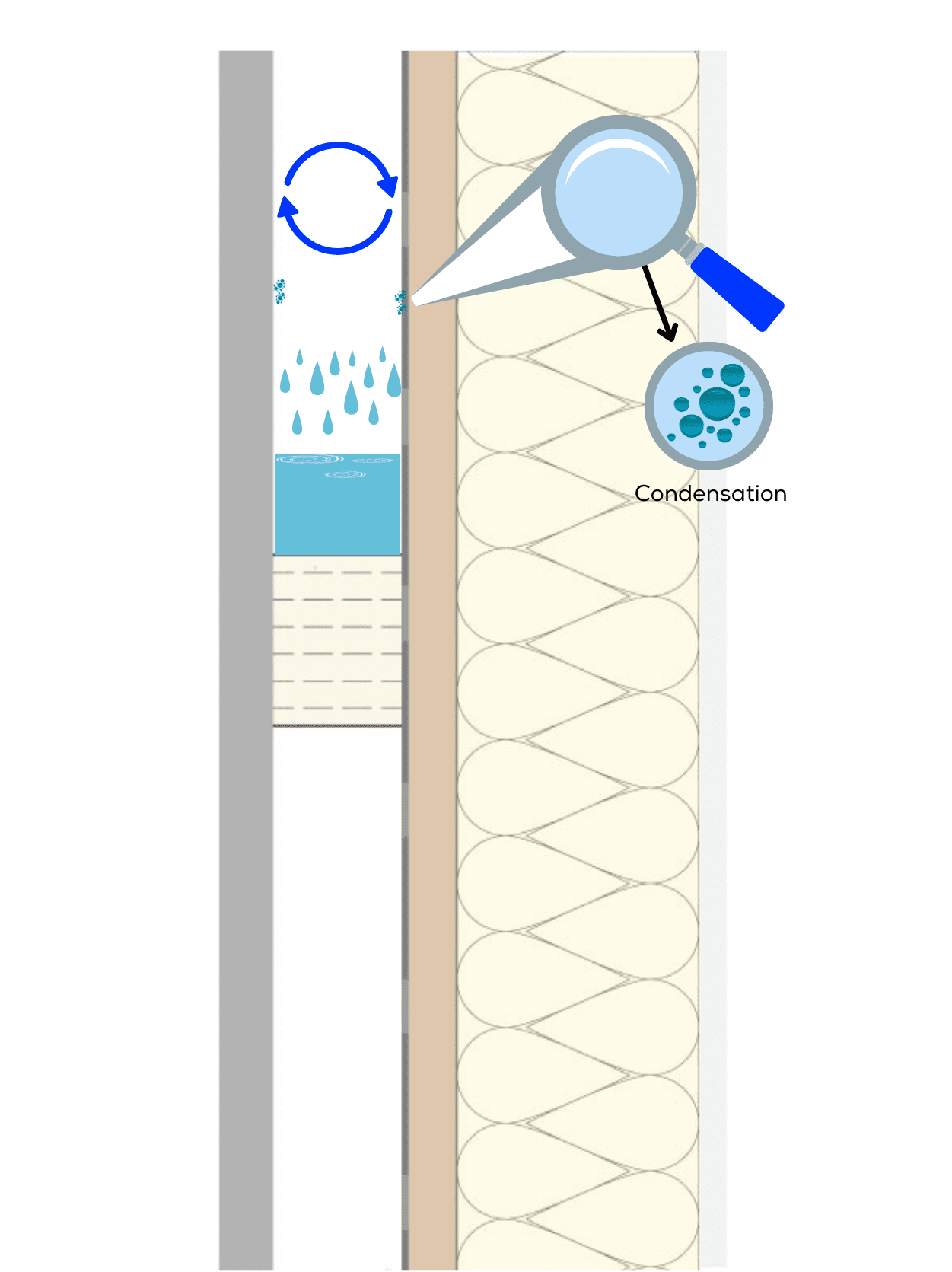
With the openness of the air cavity, this type of environment promotes 1) good air circulation, 2) moisture management, and 3) overall building efficiency. Unfortunately, when fireblocking is integrated into the air cavity, it eliminates the uninterrupted openness of the cavity. When installed, traditional fireblocking needs to expand prematurely of the fire – meaning it curates a blockage within the air cavity. This is illustrated in Figure 1.
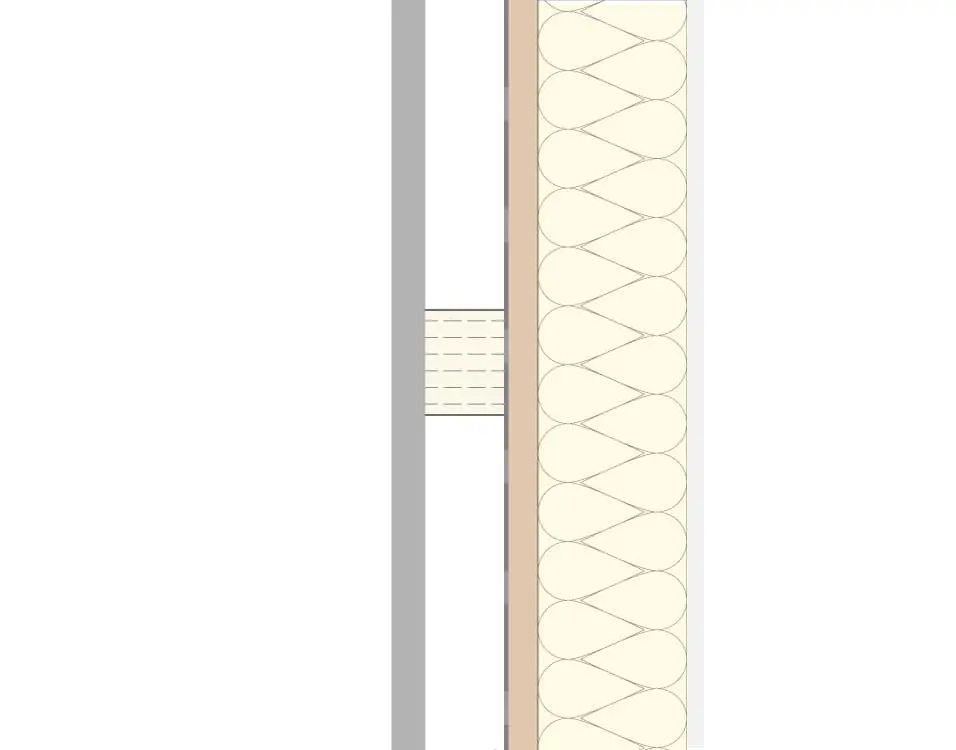
This blockage results in a lack of proper air flow and moisture management – the exact opposite of the assembly’s purpose, shown in Figure 2. With mineral wool fireblocking being one of the few approved fireblocking technologies, architects have struggled with trying to find a technology that permits maximum cavity performance without risk of not complying with fireblocking requirements.
Therefore, architects and developers have either strayed away from using this innovative energy conservation building practices or have spent more on building costs with a diminished building performance.
Prioritizing Timing in Exterior Wall Assemblies
Thus, how do we resolve these conflicting needs? … It’s all about timing.
One of biggest downsides of mineral wool is its pre-activation before a fire. With this pre-activation, the mineral wool blocks off the entirety of the air cavity, resulting in a lack of air ventilation and moisture. But what if there was a fireblocking technology, which was only activated when it mattered most?
For example, what if there was a material that allowed ventilation and drainage when there was no fire but also created compartmentalization when there was an active fire –a perfect solution for an exterior wall assembly.
Intumescents in Fireblocking Applications
Intumescents – a technology only activated when exposed to high temperatures, one of the first telltale signs of an active fire outbreak. Used in other areas of a building, such as conduits and wiring, intumescents expanded and seal off the open spaces often associated with connection between other compartments within a building.
With this type of technology, applications can operate as expected in normal conditions, and only in unfortunate circumstances, such as a fire, this technology will be activated to compartmentalize the fire outbreak. To explore the different applications intumescents can be found in, click here.
Intumescent Fireblocking in Exterior Wall Assemblies
Designed to comply with stringent fireblocking requirements and permit full performance of exterior wall cavities, Tenmat has introduced a new fireblocking technology. This technology has the potential to change the standards of fireblocking in exterior cavities for architects and design professionals. Here, we introduce the technology of Intumescent Fireblocking.
In normal conditions, Tenmat’s Intumescent Fireblocking is engineered to maintain the functionality of ventilated rainscreen systems. How? When attached to the exterior wall cavity, it is fixed to be as close as possible to the assembly – maintaining a maximum 1.75” gap within this assembly.
With this gap, the exterior wall assembly can maintain its performance standards of air ventilation and moisture management – bringing forth the sole purpose of this type of construction practice’s purpose.
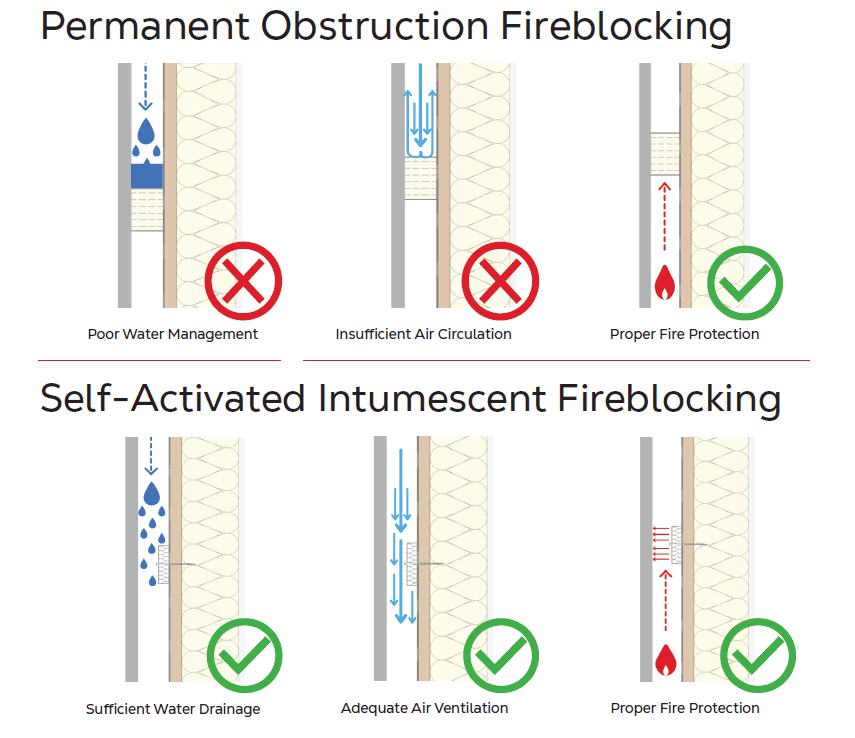
However, in the event of a fire, the intumescent fireblocking is activated by the heat output – and reacts by sealing off the gap completely. With this response, the fire is now compartmentalized. To view the full comparison between traditional fireblocking versus intumescent fireblocking, please review Figure 3.
What’s Next?
With the solution of intumescent fireblocking, architects and design professionals have been able to resolve the common challenges of fireblocking in exterior wall assemblies. With that being said, some of the following questions arise
“What is the overall functionality of intumescent fireblocking?”
“What types of cladding can intumescent fireblocking be used in?”
“Is intumescent fireblocking tested and approved?”
If you are seeking the answers to the previous questions, stay tuned for our next chapter in this series, “What is Intumescent Fireblocking”. If you have any current questions, please connect with one of our on-site experts at info@tenmatusa.com or +1-800-821-3436.