Fire Caulk & Firestopping Products for Passive Fire Protection
Think about how many wires are running through your building. Your local mall. Even your corporate office space or warehouse. Five? Ten? A hundred? Regardless, if the structure is residential or commercial, wires, cables, and pipes are running through the walls, ceilings, even the floors.
With establishing there are possibly tens of hundreds of wires and cables running throughout a singular structure, this also means tens of hundreds of openings are left unprotected. In the event of a fire outbreak, smoke, flames and heat can easily navigate through any opening, no matter how small or irregular the opening may be.
This hazard brings forth the demand for proper passive fire protection measures, such as integrating firestopping solutions and/or materials into these spaces. To protect these openings, we often see architects specifying the use of solutions, such as “fire caulk”, “fire protection sealant”, and “firestopping foams”.
Let’s put this scenario into perspective. If the second floor of a five-story commercial office building presents a fire outbreak, both the first and the remaining floors are in danger. If an architect specifies proper passive fire protection solutions, including but not limited to fire caulk and other firestopping solutions, the fire’s output will be contained to only the second floor.
Without proper firestopping, the fire will be able to accelerate floor to floor through unprotected openings, caused by cables, pipes, wires and more.
Let’s explore how Tenmat’s Fire Caulk and Firestopping Solutions keep our community’s through-penetration applications safe from unannounced fires.
Our Fire Caulk & Firestopping Products
Tenmat’s line of intumescent firestopping products have been designed to address the often-overlooked safety hazard of unprotected through-penetration openings. Each firestopping solution is designed to meet standard and nonstandard openings in a vast range of applications.
First, let’s explore the role of each one of our intumescent firestopping solutions.
FF365 Intumescent Fire Caulk
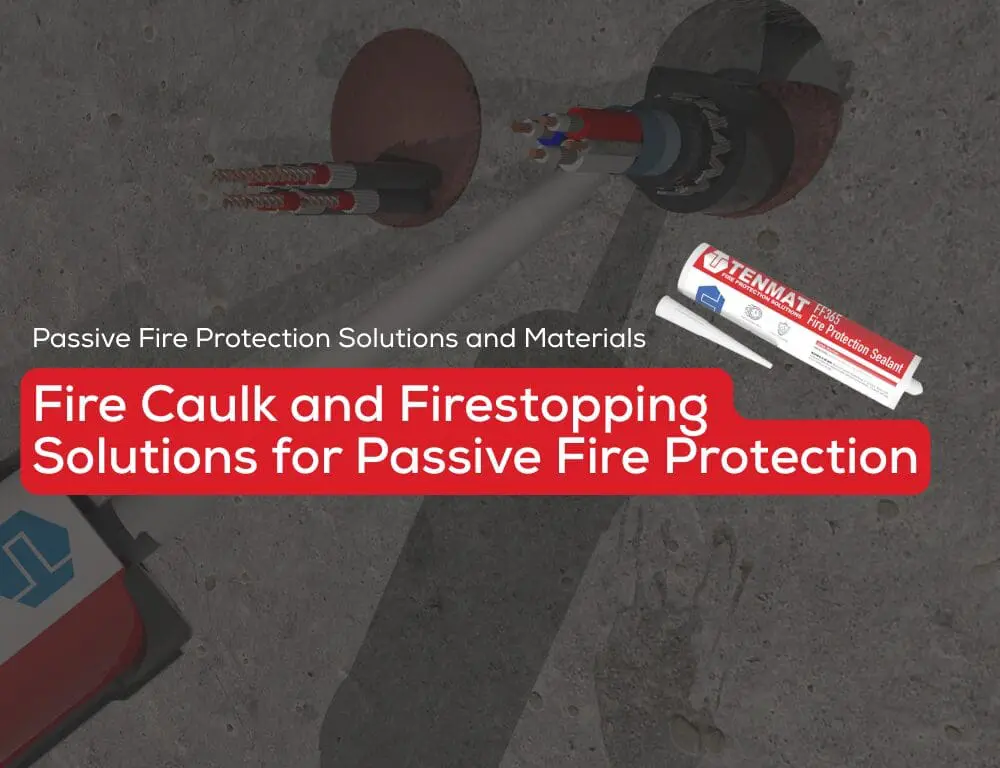
Tenmat’s Fire Protection Sealant or more commonly, our Fire Caulk is an intumescent firestopping sealant for use in a variety of UL through-penetration firestopping applications.
TENMAT’s Firestopping Caulk helps properly fire rate small membrane penetrations in walls and ceilings. Additionally, this firestopping solution helps contain the spread of flames and smoke for up to two hours, rooted from an unexpected fire outbreak.
Explore the full features of the FF365 Fire Protection Fire Caulk.
FF360 Fire Protection Foam
Composed of a firestopping intumescent, Tenmat’s Firestopping Foam helps properly fire rate membrane penetrations in walls, ceilings, and floors. With its ability to contain smoke, heat, and flames in its place of origin for up to two hours, the FF360 Firestopping Foam is suitable to protect irregular, hard-to-access, and large penetrations.
The quick curing formulation of the FF360 allows the foam to expand up to five times in volume during installation and permits the foam to be applied fast and efficiently.
Understand how the FF360 Fire Protection Foam will fit into your project.
FF260 Firestopping Block
The FF260 Fire Protection Blocks are preformed, intumescent firestopping blocks for sealing penetrations with cables, cable trays, cable bundles, metal pipes, and mixed penetrations.
Made of a rapidly expanding intumescent foam, the FF60 Fire Protection Block is the ideal fire barrier for openings on solid floor or ceiling systems. With its flexible and lightweight composition, the FF260 Fire Block is suitable for retrofitting installation, as well as new construction of through-penetration firestopping systems.
View the FF260 Fire Protection Block in action here.
FF160 Fire Protection Plug
Our FF160 Fire Protection Plug is made of a rapidly-expanding intumescent foam – specifically designed for standard through-penetration openings. This firestopping plug is UL classified for a maximum of 60% cable fill in openings of max. 5” diameter in concrete and can be easily cut to pass wires or cables through them.
With its high expansion and insulating properties, the FF160 Firestopping Plug ensures that both flame and heat spread are stopped for 120 minutes.
Learn more about Tenmat’s FF160 Firestopping Foam.
What Is Fire Caulk and How Does It Work
With the understanding of how Tenmat’s Fire Caulk and Other Firestopping Solutions operate, it is important to simply understand the foundation of how this technology works. So, what is fire caulk and how does it work?
Fire caulk, often known as “firestopping sealant”, is an innovative material engineered as a primary component of a passive fire protection system. Its primary function is to reinforce the fire-resistance rating of walls, floors, and ceilings where they have been compromised by an installation or general gaps.
Specifically formulated to seal openings and joints, fire caulk creates a barrier that resists the passage of flame, heat, and smoke. The use of this innovative sealant ensures that fire compartmentalization remains intact throughout a structure.
How Does Firestopping Work in the Field?
In the instance of any fire outbreak, either internal or external, the first telltale sign of any fire is the high levels of heat output. Therefore, integrating a solution, where it reacts to high temperatures is essential – such as an intumescent.
When exposed to high temperatures, an intumescent-based caulk rapidly expands – several times its original size. After expanding, the intumescent material forms a solid, non-combustible char. This char effectively slows the transfer of heat from the fire side to the non-fire side of the wall assembly – compartmentalizing the fire to its place of origin.
Unlike the plastic components of wires and pipes, the intumescent’s char is highly rigid and exhibits very low thermal conductivity, which is critical when trying to delay temperature rise on the unexposed side of the assembly.
Fire Caulk Applications
Previously, we have addressed that fire caulk and other firestopping solutions tend to arise in a multitude of various construction applications. Why? Simply because cables, pipes, and other through-penetration openings are in almost every structure within our communities. Let’s review some of the most common applications.
Data Centers
Housing a significant amount of critical equipment, such as servers, switches, storage devices, and lithium-ion batteries, data centers are a major hub for cables, wires, pipes, and everything in between.
Often, architects are faced with not only standard through-penetration openings – but also irregular through-penetration openings. For those irregular, small through-penetration openings, Tenmat offers two fire-caulking type solutions, the FF360 Fire Protection Foam and FF365 Firestopping Sealant.
Both the Fire Protection Foam and Sealant are engineered to reinforce irregular, hard-to-access, or large penetrations in fire-resistance rated ceilings, floors, and walls. The high expansion and insulating properties of the intumescent materials ensure that both flame spread and smoke are stopped for 120 minutes.
With these firestopping materials, architects and contractors can protect the mass amounts of sensitive digital information and computers that are being housed in data center facilities.
Learn more on our Data Center application page.
Healthcare
Designed with a large-scale sanitary drainage system and electric grid, healthcare centers, such as hospitals and assisted living facilities, hold a wide range of openings caused by through-penetration applications.
To protect patients and healthcare professionals, using one of Tenmat’s Firestopping Solutions and Materials will allow unprotected through-penetration openings to be properly reinforced.
Our UL-Listed FF160 Fire Protection Plug is an ideal firestopping solution when working with a retrofitting installation, as well as new construction of power and control cables, telecommunication cables, and optical fiber cables.
Additionally, our Firestopping Plug can be used in combination with our Firestopping Foam to properly seal irregular, hard-to-access small penetrations effectively.
Discover more on our Healthcare application page.
Industrial and Commercial
From expansive commercial warehouses to state-of-the-art manufacturing facilities, a wide range of these applications have irregular, hard-to-access, and/or small penetrations. As we previously stated, these openings, no matter how small or large, are a gateway to a fire outbreak accelerating throughout a building.
In response to this, Tenmat offers standard solutions such as our FF160 Firestop Plug and FF365 Fire Caulk, to reinforce the compromised integrity of fire-resistance rated drywall or concrete wall and/or ceiling.
The FF160 Fire Protection Plug, made of a rapidly expanding intumescent foam, is the ideal solution for through-penetration firestop systems. Its flexible and lightweight materials allow for decreased project lead times and permit accessibility to penetrate additional wires through this fire-tested and approved solution.
If you are seeking to fire rate smaller wall penetrations, Tenmat offers a fire protection sealant, the FF365. This sealant is recommended for blank openings, metal pipes, conduits, wires, and mixed penetrations on solid floors and ceilings.
Its high expansion and insulating properties of the material ensure that both flame spread and smoke are stopped for 120 minutes.
Explore further on our Industrial and Commercial Application Page.
Fire Caulk vs Other Firestopping Solutions
Often, we get the question, “What is the difference between fire caulk and standard caulks used in construction applications?”. The key difference between standard caulk and fire caulk is the composition of the caulks/sealants themselves.
Commonly composed of either acrylic latex or silicone, standard construction caulks are formulated for weatherproofing, moisture resistance, and general gap filling. With this being said, these formulations are essentially combustible and do not perform well when trying to contain a fire.
And this is where we introduce the innovation of fire-rated caulk. As we pointed out earlier, we said fire caulk is often composed of noncombustible material, such as intumescent. With being manufactured with this type of material, fire-rated caulks actively expand when exposed to high temperatures. This expansion results in a rigid, insulated char – a performance standard sealant cannot meet.
With this understanding, it is apparent that architects and contractors need to specify firestopping solutions to protect unprotected through-penetration openings. But how does one identify if a caulk is fire rated?
Firestopping Compliance and Testing
One of the main ways to identify if a caulk is fire-rated is to simply check to see if the solution underwent proper testing. The International Building Code (ICC) requires that Penetration Firestop Systems be listed in Section 714 and have an ASTM E814 or UL 1479 certification.
ASTM E814 (UL 1479)
“This test method is used to determine the performance of a firestop system with respect to exposure to a standard time-temperature fire test and hose stream test. Two ratings shall be established for each firestop system.
An F Rating shall be based upon the flame occurrence on the unexposed surface, while the T rating shall be based upon the temperature rise as well as flame occurrence on the unexposed surface of the firestop system.
These ratings, together with detailed performance data such as the location of through openings and temperatures of penetrating items are intended to be one factor in assessing performance of firestop systems.” (Source: Intertek).
View the full test details here.
If a caulk supports this certification, it indicates that it has undergone proper testing. To verify the solution’s certification, check with the appropriate testing laboratory listing to ensure proper compliance.
Final Thoughts
Today, we discovered the role fire caulk plays in a building’s passive fire protection system. With this innovative technology, any application that houses through-penetration systems is able to properly reinforce the compromised fire-resistance rated ceiling, floor, or wall.
Regardless of how irregular or small of an opening, fire caulk will be able to contain smoke, flames, and heat to its origin – critical when protecting lives and property. However, it is more critical to verify if the caulk has received proper tests and certifications.
At Tenmat, we offer a UL-Classified Fire Caulk and other firestopping solutions for through-penetration applications. If you are interested in learning more about these advanced firestopping solutions and materials, please connect with us at info@tenmatusa.com