Learn how the standards of fireblocking in exterior wall assemblies have changed after introducing intumescent fireblocking into the most stringent construction landscape – New York City.
In our Intumescent Fireblocking Series, we have introduced a wide range of topics surrounding the general topic of fireblocking in exterior wall assemblies. In our series, we established:
- When fireblocking is required in ventilated rainscreen systems,
- Where fireblocking should be specified in a modern rainscreen assembly, and
- The challenges architects face with fireblocking in ventilated rainscreen assemblies.
If this is the first article you have come across, we suggest you starting with our first article, “When is fireblocking required in ventilated rainscreen systems?”, so, you don’t miss the basics of fireblocking in ventilated rainscreen systems.
In today’s article, we will continue expanding on the topic of intumescent fireblocking from our previous blog, “The Challenges of Exterior Wall Fireblocking”. From understanding the functionality of intumescent fireblocking to how it has changed the standards of fireblocking, this article will allow you to gain the basic knowledge of this innovative technology. Now, let’s dive in!
What is intumescent fireblocking? How does it work?
Intumescent fireblocking – an innovative fireblocking technology engineered to maintain the balance of performance and compliance in ventilated rainscreen assemblies. Prior to this technology, traditional fireblocking solutions posed several challenges that limited architects in their design freedom.
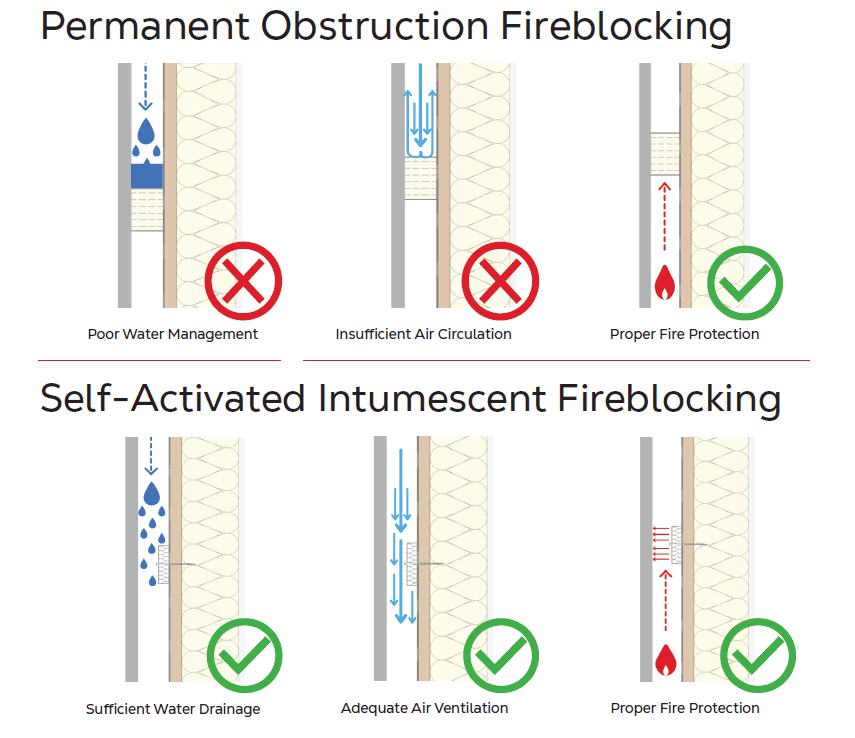
Unlike intumescent fireblocking, traditional fireblocking is activated during normal operations, not just when a fire is present. With this activation, this type of fireblocking sections off certain parts of the ventilated air cavity. This results in a negative performance in both air circulation and moisture control. Ultimately, defeating the purpose of incorporating a ventilated rainscreen assembly.
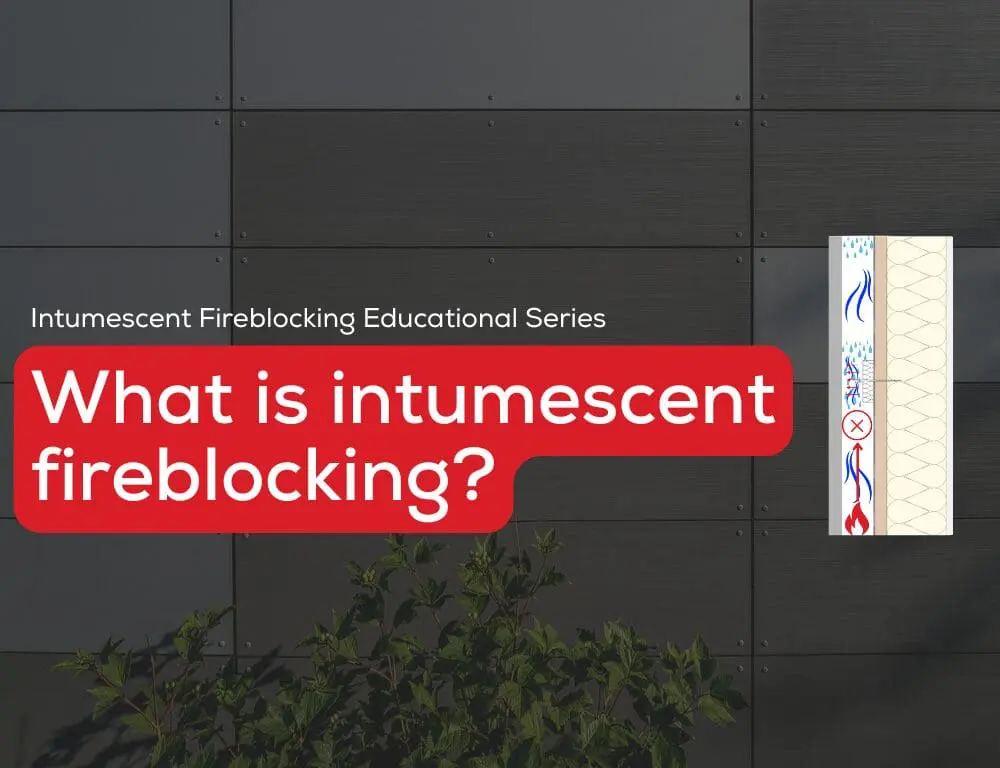
With the use of intumescent fireblocking, the technology is only activated when exposed to high temperatures. In normal conditions, an intumescent fire block is attached to the mineral wool of the exterior wall assembly – leaving of 1.75” gap between the face of the intumescent fire block and the exterior wall.
As a result of this, the gap allows for proper air circulation and moisture management in the air cavity – bringing forth the true purpose of installing a ventilated rainscreen system.
View Figure 1 to see the difference between using traditional fireblocking versus intumescent fireblocking in an exterior wall air cavity.
Is intumescent fireblocking tested and approved?
At this time, there is only one tested and approved intumescent fireblocking, Tenmat’s Intumescent Fire Blocks. Tenmat’s Intumescent Fire Blocks have undergone extensive fire testing, such as NFPA 285. However, there is one test that sets Tenmat’s Intumescent Fire Blocks apart from other intumescent fireblocking.
With its NYC OTCR/DOB approval in accordance with Section 718.2.1, Tenmat’s Intumescent Fire Blocks are the only approved intumescent approved for the NYC landscape.
How has this NYC OTCR/DOB approval changed the landscape for New York City?
With its NYC OTCR/DOB approval, Tenmat’s Fire Block has created a major break-through for cladding OEMs and architects within New York City. With this approval, it has allowed architects to re-enter applications that were once banned from the NYC landscape (as of 2022). This opportunity allows for freedom in architectural design – resulting in no limitations in building materials and applications.
What types of cladding applications can intumescent fireblocking be used in?
In addition to our NYC/OTCR DOB approval, Tenmat’s Intumescent Fire Blocks has had several successful NFPA285 tests with a variety of assemblies with different cladding and insulation manufacturers.
From ACM (Aluminum Composite Material) Cladding to HPL (High Pressure Laminated) Cladding, Tenmat’s Intumescent Fire Blocks has performed successfully in a wide range of cladding applications. If you are interested in learning more about each one of our successful NFPA 285 tests, contact one of our on-site experts.
Final Remarks
By introducing an innovative fireblocking technology, such as intumescent fireblocking, architects have finally uncovered the balance of maintaining design performance while complying with stringent fireblocking requirements in a ventilated rainscreen assembly.
From its range of successful NFPA 285 tests and upcoming project specifications, Tenmat’s Intumescent Fireblocking has allowed opportunity back into some of the most stringent cityscapes, such as New York City. If you are interested in using Tenmat’s Intumescent Fire Blocks in your next project, let’s connect.