What is active fire protection?
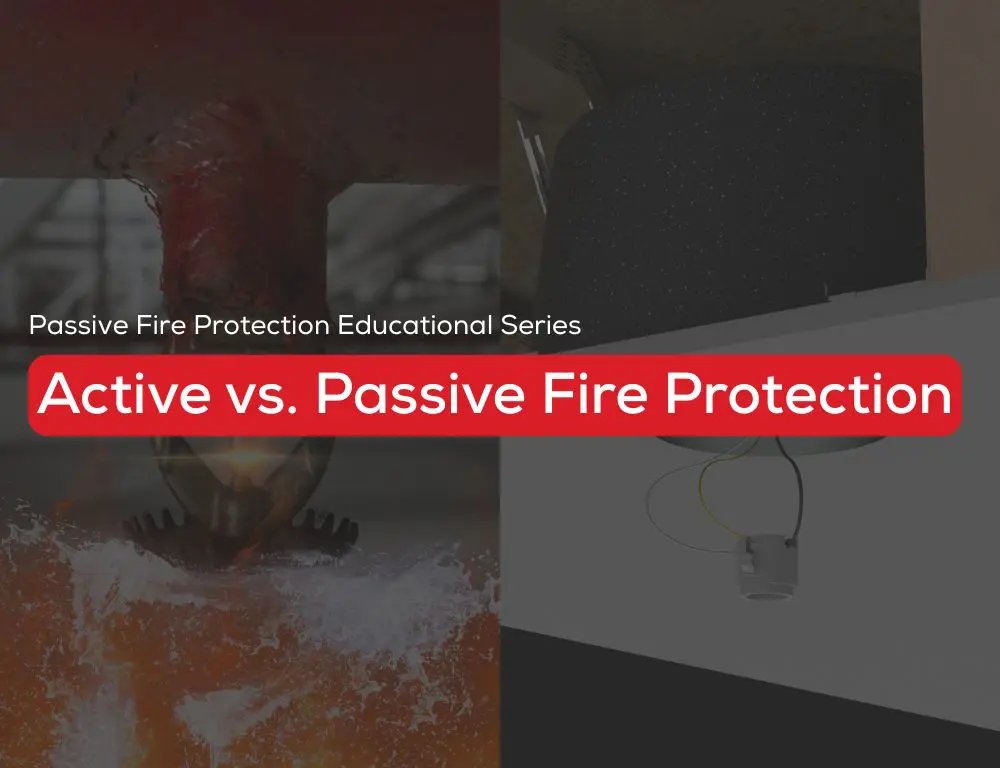
Active fire protection covers the systems that do something when a fire starts. They detect it, raise the alarm, or fight the flames directly. Almost all of them need a trigger, a power or water supply, or a person to operate them, which means they only work once a fire is already underway.
Typical active systems include:
- Automatic sprinkler systems and other fixed suppression systems
- Fire alarms, smoke detectors, and heat detectors
- Portable fire extinguishers
- Standpipes and fire hoses used by occupants or the fire service
- Smoke control and extraction systems that keep escape routes clear
Because they move, switch on, and rely on a supply, active systems have to be tested and maintained. A sprinkler head that’s painted over or a valve that’s been closed for maintenance is an active system that won’t act when it’s needed.
What is passive fire protection?
Passive fire protection is built into the fabric of the building. It doesn’t switch on and it doesn’t move. Its job is to contain a fire in the compartment where it started, slow the spread of flame and smoke, and protect the structure long enough for the building to be evacuated safely. This idea of dividing a building into fire resistant compartments is the backbone of passive protection.
Common passive measures include:
- Fire rated walls, floors, and ceilings that resist fire for a set period, such as one or two hours
- Fire doors and fire rated glazing that keep compartment boundaries intact
- Firestopping around penetrations where pipes, cables, and ducts pass through rated walls and floors
- Fire rated enclosures for recessed lights, LED luminaires, troffers, and in-ceiling speakers
- Intumescent materials that expand under heat to seal gaps and openings
- Cavity barriers and rainscreen fireblocking that stop fire spreading unseen through facade voids
Passive protection works from the first second a fire produces heat, with no signal or supply required. It’s only as good as its weakest point though. A single unsealed cable penetration or an unprotected light fitting can let fire and smoke pass straight through an otherwise rated ceiling.
Active vs passive fire protection at a glance
| Active fire protection | Passive fire protection | |
|---|---|---|
| What it does | Detects, alerts, and fights the fire while it is happening. | Contains the fire and slows its spread through the structure. |
| How it works | Needs a trigger, power, water, or a person to operate. | Built into the building. Always in place, nothing to switch on. |
| Examples | Sprinklers, alarms, smoke detectors, extinguishers, standpipes, smoke control. | Fire rated walls and floors, fire doors, firestopping, fire rated enclosures, intumescent materials. |
| Main IBC home | Chapter 9, fire protection and life safety systems. | Chapters 6 and 7, construction types and fire resistance features. |
| When it acts | Only during a fire event. | Every second of the building’s life, the moment heat or flame arrives. |
What the building code requires
In the US, the International Building Code (IBC) sets the baseline for both types of protection, and requirements scale with a building’s occupancy, height, and construction type.
Passive fire protection is covered mainly in Chapter 6, which defines construction types and their required fire resistance ratings, and Chapter 7, which sets the rules for fire and smoke protection features such as fire walls, fire barriers, fire partitions, and horizontal assemblies. Section 714 within Chapter 7 governs penetrations, the points where services pass through rated assemblies and where firestopping is required. Active fire protection systems sit in Chapter 9, fire protection and life safety systems, which covers sprinklers, alarms, standpipes, and smoke control.
The two are treated as linked. Where a building is fitted with automatic sprinklers throughout, the IBC allows some passive requirements to be reduced. That trade off only holds because both systems are accounted for together, so weakening one side of the balance has consequences for the other.
The code is explicit about protecting rated ceilings where fixtures penetrate them: Where floor/ceiling assemblies are required to have a fire-resistance rating, recessed fixtures shall be installed such that the required fire resistance will not be reduced.
The 2015 IBC addresses this directly in Section 714.4.2, which is exactly where fire rated light covers earn their place.
Why buildings need both
Neither system is enough on its own, which is why the code and good practice call for both.
Active without passive: sprinklers might control a fire, but if they fail, run out of water, or are isolated for maintenance, nothing is left to contain it. Fire and smoke then move freely through unsealed walls, floors, and ceilings.
Passive without active: compartmentation slows a fire and protects the structure, but on its own it won’t alert occupants or put the fire out. People still need warning and a way to fight small fires early.
Put together, they give a building layered protection. Active systems tackle the fire and warn people. Passive systems contain what’s left and keep escape routes and the structure sound. Each covers the other’s blind spots, and that redundancy is the point.
Where Tenmat fits
Tenmat manufactures passive fire protection products for the construction sector across the US and Canada. The range includes fire rated recessed light and LED downlight covers, fire rated troffer and speaker covers, firestop foams, sealants, blocks and plugs, rainscreen fireblocking, and intumescent materials. Every product is fire tested and classified by independent labs, either UL classified or Intertek tested, so it can be specified with confidence against IBC requirements.
For architects and specifiers, that means passive measures that hold up under inspection. For contractors, it means ready-to-use products that install fast with no assembly. For inspectors, it means recognized third-party classifications that make sign-off straightforward.
Specifying passive fire protection for your next project? Request a quote or talk to the Tenmat team about the right product for your assembly.
Frequently asked questions
What is the difference between active and passive fire protection?
Active fire protection fights a fire while it is happening, using systems like sprinklers, alarms, and extinguishers that need a trigger or power. Passive fire protection is built into the structure. It contains the fire and slows its spread without moving or switching on.
Is a sprinkler system active or passive fire protection?
A sprinkler system is active fire protection. It detects heat and releases water to fight the fire directly, so it only acts once a fire has started. Passive measures such as fire rated walls and firestopping work continuously without being triggered.
Does a building need both active and passive fire protection?
Yes. The two systems do different jobs and cover each other’s gaps. Active systems fight the fire but can fail or be shut off for maintenance. Passive systems contain it and protect the structure regardless. The building code assumes both are present.
What does the building code say about passive fire protection?
In the US, the International Building Code covers passive fire protection mainly in Chapters 6 and 7, including fire rated assemblies and firestopping of penetrations under Section 714. Active systems sit in Chapter 9. Requirements vary by occupancy and building height.
Are fire rated recessed light covers active or passive fire protection?
Fire rated recessed light covers are passive fire protection. They restore the fire resistance rating of a ceiling where a recessed light or LED fixture has penetrated it, keeping the compartment sealed. Tenmat’s FF109 covers are UL classified for this purpose.