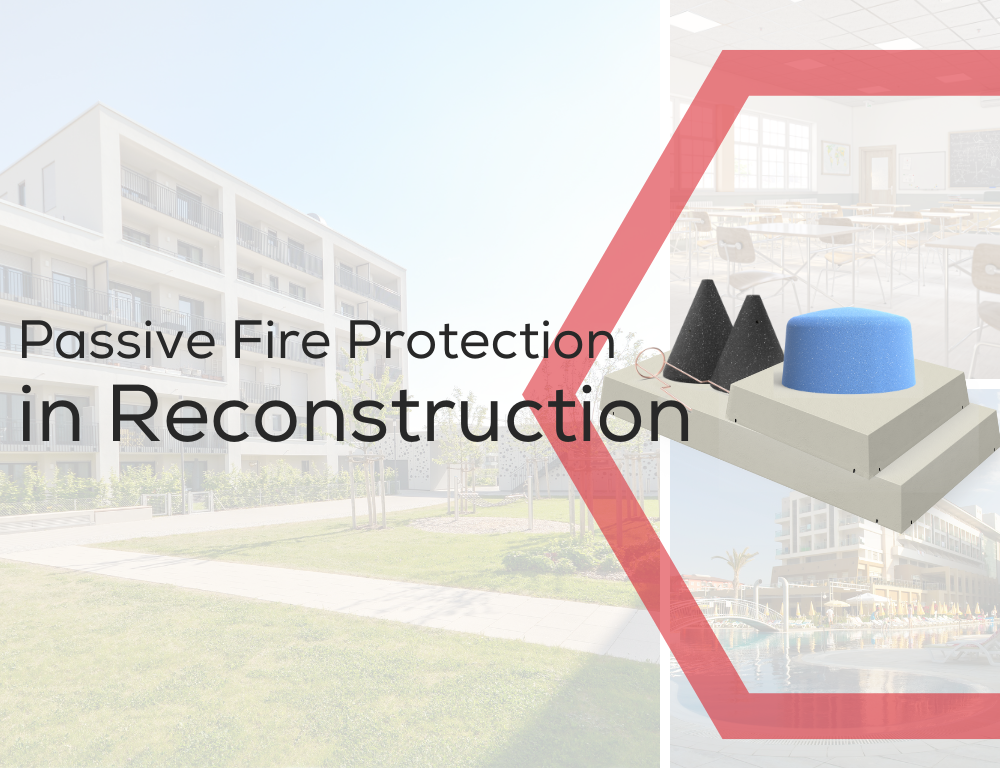
Explore the process of specifying appropriate passive fire protection solutions into active and future reconstruction projects.
Opening Up the Floor – or Ceiling.
In the modern world of construction, we always discuss the latest practices and technological innovations for new construction. So, what about pre-existing buildings? From preserving historical structures to repurposing outdated buildings, redevelopment projects have become the norm. However, construction professionals are facing a huge challenge – specifying appropriate passive fire protection systems into these modernized infrastructures. And to ensure an extra layer of difficulty? The installation of these systems into a pre-existing ceiling assembly.
Addressing Growing Life Safety Hazards
To assist construction professionals on navigating through these challenges, this article will address:
- The purpose of implementing passive fire protection, and how it coordinates with previously installed active fire protection systems,
- Why passive fire protection is essential when renewing the lighting and/or audio systems in pre-existing buildings, and the
- Key strategies and common mistakes that arise when specifying passive fire protection in ceiling upgrades and renovations.
Through this detailed examination, you’ll be equip with the insights to properly protect the lives and properties in your next relighting renovation. Let’s begin.
Distributing Passive and Active Fire Protection in Reconstruction.
Traditionally, architects have full awareness on what building code requirements are triggered with their details – in new construction. When working on another team’s project, architects are unsure what codes have been addressed and not addressed. Now, imagine trying to evaluate a project from several years ago.
Local jurisdictions adopt new fire protection standards yearly. Therefore, with confidence, it’s safe to say the standards of fire protection are outdated in redevelopment projects. By recognizing this, project teams can begin to update the structure’s fire protection system. By being in view, active fire protection systems are able to be easily altered to meet the latest building code requirements. Active fire protection includes solutions such as sprinklers and fire extinguishers.
On the other hand, addressing the updates in passive fire protection systems tends to go unnoticed. Why? Well, for starters, passive fire protection tends to be hidden from the human eye in normal conditions. It’s not until the project team begins to go behind the walls and into the ceilings where the lack of compliance becomes present. Even worse, in reconstruction projects, project teams tend to find an extreme lack in passive fire protection.
Why Do You Need to Update Passive Fire Protection Systems?
If project teams do not address the outdated compliance or sheer lack of passive fire protection, the building is compromised. One the main reasons on why we specify passive fire protection in the first place is to protect lives and property. As I previously mentioned, passive fire protection tends to fly under the radar in reconstruction projects because of its lack of visual appearance. However, if you and your team look at the ceiling – you are actually looking at several fire protection violations – unprotected ceiling openings.
Many architects and developers tend to be unfamiliar with or even overlook Section 714.5.2 of the 2021 IBC. This section of the building code addresses the requirement for reinstating penetrations in a fire-resistance rated ceiling. When penetrating a fire-rated assembly with a recessed light or audio fixture, the fire rating of this assembly becomes jeopardized. When exposed to the high temperatures of a fire. the ceiling fixture is reduced to nothing. Once deteriorated, a fire can easily accelerate throughout a building – leaving nothing but destruction and chaos.
To resolve this danger, professionals have begun specifying proper passive fire protection measures. This includes certifying that these openings are sealed properly with an approved, fire-rated solution. In new construction, this task can easily be integrated. Unfortunately, in reconstruction projects this is not the case.
Key Tools to Successful Relighting Projects.
When determining the integrity of your fire-rated ceiling, first you need to verify if the ceiling even needs to uphold a fire rating. As previously stated, it is common for contractors to not recognize the demand for passive fire protection for in-ceiling fixtures. Especially if there isn’t any current passive fire protection present. Therefore, it is extremely critical to review your project’s plan and your local code’s requirements. After this determination, you’ll need to select appropriate fire-rated solution(s) for the project. To name some of criteria to ponder in this selection is:
- Does the fire-rated solution align with the stringent building code requirements in the Internation Building Code?
- Has the fire-rated solution been properly tested and certified by an accredited third-party laboratory?
- Will the installation of this solution meet the project’s personal demands, such as expected lead times and retrofitting demands?
When making this decision, it is important to recognize if the solution can be installed into a pre-existing ceiling. Majority of fire-rated solutions, such as traditional fire-rated drywall boxes, are unable to installed into a pre-existing ceiling. This tends to add major delays in project lead times and astronomical labor costs. Here at Tenmat, we have acknowledged these universal complications. In response, we have designed a line of fire-rated solutions to meet more than just the building code. But, the demand of the individuals, who will be specifying and installing these solutions. Explore the benefits of choosing Tenmat’s Fire Rated Covers for relighting upgrades in pre-existing ceilings below:
Passive Fire Protection for Recessed Lighting Fixtures.
- Universally, pre-existing buildings are looking to decrease their monthly energy costs – opting in for energy-efficient light fixtures. Some of the popular lighting fixtures used to complete this request include LED downlight wafers and troffer luminaires. At Tenmat, we have formulated a line of fire-rated enclosures to properly fire rate either an LED downlight or troffer. Understanding that these solutions will need to be placed into a pre-existing ceiling, Tenmat’s Fire Rated Covers for LED downlights and troffer luminaires can easily be retrofitted into the ceiling. To further explore this fire-rated technology, please click here.
Passive Fire Protection for In-Ceiling Loudspeakers.
- As interior ambience and environment become an essential part of modern-day design, implementing in-ceiling loudspeakers have been a common upgrade in commercial spaces. However, the installation of these loudspeakers does expose the integrity of the fire-rated ceiling’s composition. Engineered to be retrofitted into a pre-existing ceiling, Tenmat’s FF109-FRSC 1 Hr. Fire Rated Speaker Cover is tailored to fire rate a wide range of in-ceiling loudspeakers, regardless of manufacturer or model. To learn more about the FF109-FRSC and its additional benefits, please click here.
If you any additional questions about Tenmat’s technology, please feel free to contact us.
Common Mistakes in Relighting Projects.
With a clear vision on how an individual should proceed when working with passive fire protection in ceilings, it’s time to address some of the common mistakes one can face during installation. One of the most common mistakes during relighting upgrades is failing to maintain the integrity of specified fire-rated solutions. Cutting through fire-resistant ceilings to install new lighting fixtures or in-ceiling loudspeakers often leads to gaps or penetrations that are not properly sealed afterward.
This oversight can significantly compromise the compartmentation of a building, allowing smoke and fire to spread more rapidly in an emergency. Contractors may also use incorrect materials for sealing penetrations, such as non-rated sealants, which do not meet fire protection standards. Ensuring that all penetrations are sealed with tested and approved fire-stopping systems is critical to maintaining the fire-resistance rating of the structure. To avoid this common issue, all Tenmat’s Fire-Rated Solutions do not require any additional tools or materials upon installation.
Is your fire protection properly tested and approved?
Still and all, there is one last major mistake that curates an improper fire-rated resistance ceiling. Specifying improperly fire tested and certified products and materials. Repeatedly, contractors and specifiers have failed to recognize the difference between a solution that holds a proper vs. improper fire rating. For a solution to uphold a proper fire rating, the solution needs to undergo proper testing and certification from an accredited third-party testing facility, such as UL and Intertek.
To review a product’s testing and certification, simply visit the manufacturer’s website, and review the solution’s listing, test report, or certification. If you are unable to locate the certification or questioning the authenticity of the certification, you can visit one of the national and international acclaimed independent third-party testing laboratories, such as Underwriter Laboratories (UL) or Intertek, and verify the solution’s testing. If you are unable to find the proper certification, the “fire-rated solution” is not properly fire tested. All of Tenmat’s Fire Rated Covers are properly tested and certified testing laboratories, such as UL and Intertek.
Conclusion
To wrap up this entire article into one statement, passive fire protection is a critical and often overlooked aspect of relighting renovations in existing buildings. As urban infrastructure evolves and renovation projects become more common practice, ensuring the safety of both the structure and its occupants must remain a top priority. Properly specifying and installing fire-rated solutions is essential for preserving the integrity of fire-resistance rated assemblies, particularly in ceiling upgrades that are often subject to unprotected openings caused by recessed lights and in-ceiling loudspeakers. By understanding the importance of both curating a cohesive fire protection system that incorporates both passive and active fire protection, construction professionals can not only comply with current building codes but also enhance the overall safety of redevelopment projects.
Avoiding common mistakes. By taking the time to select high-quality, certified fire-rated products, like Tenmat’s Fire Rated Covers, construction teams can streamline the installation process, reduce delays, and ultimately provide greater peace of mind for building occupants. As the industry continues to innovate, combining modern technologies with reliable, passive fire protection will remain a cornerstone in ensuring the safety and longevity of both existing and future buildings.